

Lead counsel discusses landmark Cowichan title case at TRU Law
Students at Thompson Rivers University and members of the Kamloops community were treated to an in-depth presentation on March 24 by David M. Robbins, a partner at Woodward and Company Lawyers LLP and legal counsel for the Quw’utsun (Cowichan) Nation. Mr. Robbins served as lead counsel in the recent landmark judgment Cowichan Tribes v. Canada, 2025 BCSC 1490, in which the court declared Quw’utsun Aboriginal title to their national settlement lands at Tl’uqtinus on the main channel of the Fraser River near its mouth.
With 24 years of practice, Robbins has successfully advocated for Indigenous Nations at all levels of court. He notably served as counsel for the Tsilhqot’in Nation in historic rulings, including the 2014 Supreme Court of Canada decision that issued the first-ever declaration of Aboriginal title in Canada.
During the event, Robbins provided clarity on the Cowichan judgment, explaining that the Cowichan did not seek to invalidate any private fee simple titles on their Aboriginal title lands. Instead, Robbins said, they sought and received a court declaration that the B.C. government has a duty to honourably negotiate, in good faith, reconciliation of these interests in the land.
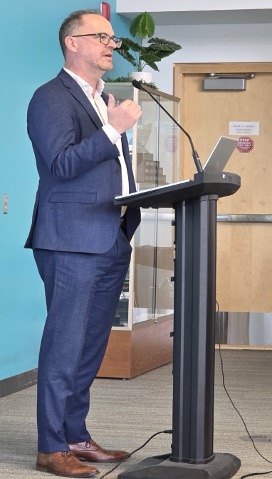
David M. Robbins, partner at Woodward and Company Lawyers LLP and legal counsel for the Quw’utsun (Cowichan) Nation, addresses students and community members at TRU Law.
“Mr. Robbins’ presentation was fantastic. The Cowichan case is extremely complex, and we are very grateful that he could present at our school to help provide some clarity on what the decision stands for. We hope that he will come back soon!” said John Hawthorne, a third-year law student who will be articling at Fulton and Company.
Robbins carefully took those assembled — a large crowd in the TRU Faculty of Law’s reading room — through the case’s executive summary, explaining each element. The Cowichan were successful on nearly every point, Robbins explained. He stressed that the Cowichan proved their Aboriginal title according to British common law — requiring sufficiency and exclusivity of occupation at the date of Crown sovereignty in 1846 — but also according to Central Coast Salish property law. Because of this, Robbins said, the case was groundbreaking for the incorporation of Indigenous laws as part of the Canadian legal system.
Critically, Robbins stressed that this case is “… a story of Cowichan oppression,” and that “it [was] very hard to read certain portions of the judgment. There was callous Crown colonization.”
Part of that colonization, Robbins explained, was a broken promise made by James Douglas, mainland British Columbia’s first governor. Robbins detailed that in 1853, Douglas told the Cowichan that the Queen (Victoria) had given him a special charge to treat them with justice and humanity, so long as they remained at peace with settlers. Despite Douglas’s promise, Crown authorities never finalized a reserve of the Cowichan’s settlement lands at Tl’uqtinus; instead, they were sold to land speculators by the Province of British Columbia, and Crown authorities at all levels repeatedly denied or ignored the Cowichan’s protestations.
These settlement lands, and these lands alone, became the basis for Cowichan’s title claim. As Robbins said, “this case was never about money. It was always about their homeland.”
“Mr. Robbins’ presentation was an extremely valuable contribution to the discourse surrounding what has become an extremely controversial case,” said law professor Murray Sholty, who organized and emceed the event. “Mr. Robbins’ explanation of the finer points of the case, and willingness to engage with the many ugly historical events this case revealed, was admirable. We are very appreciative that he made the time to present to our school and community, and we hope that he will come back in the future.”
Third-year law student Deonte McCarthy, who hopes to practise Aboriginal law at Lawson Lundell, a full-service law firm in Kelowna, said, “Mr. Robbins’ talk was helpful to clarify some of the finer points around this case. There was a reason it took five years of trial and hundreds of pages to write the decision. This is a mammoth case that got to the heart of the history of British Columbia’s dispossession of Indigenous peoples’ lands, and we were so lucky that Mr. Robbins could distill the case into such an engaging lecture.”
TRU Law is grateful that Robbins made the time to present to students, faculty and the community.
Read the executive summary of the judgment.