
Safe bike parking project identified priorities for Kamloops cyclists
Cover photo by Gisela Ruckert
The City of Kamloops’ Community Climate Action Plan calls for increasing the share of local trips made by “active transportation.” Helping more people feel comfortable to get around by bike is key. Two things are seen as necessary: safe routes and secure parking.
Opportunities to advocate for separated bike lanes is always on the radar, but this year we decided to focus on safe parking as well because we hear so often that fear of bike theft is a concern to many who would consider bicycle commuting. So Transition Kamloops teamed up with the Kamloops Cycling Coalition to (1) identify priority locations to install bike parking infrastructure and (2) create an action plan. A Climate Action Grant from the City of Kamloops covered the main costs of this project.
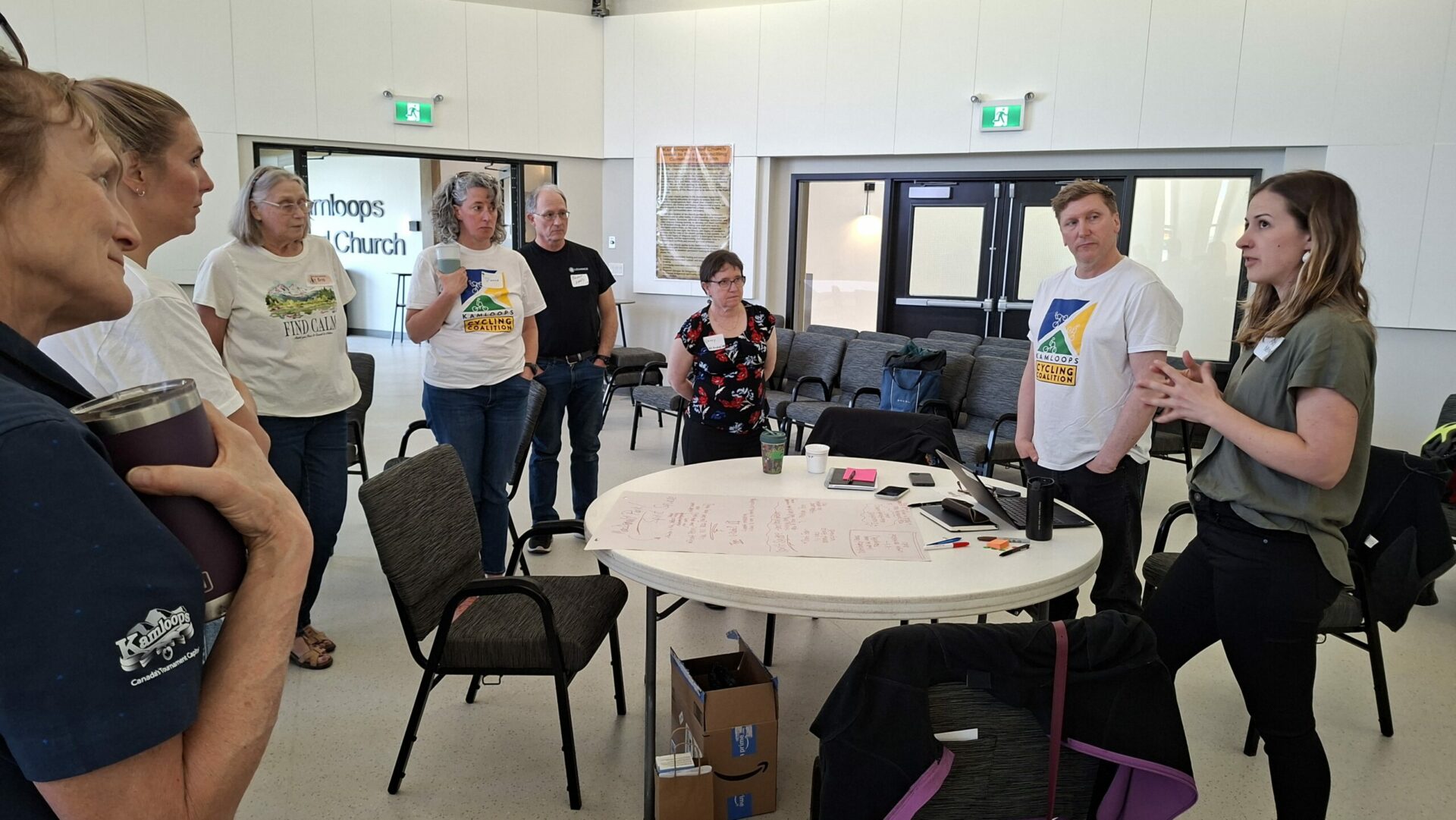
In March 2026 our action team leaders met for a planning meeting with cyclists, City staff, businesspeople and representatives from various agencies, and got very helpful feedback. We then sent an online survey to the cycling community, and organized a 4-hour workshop on April 18, 2026 for participants to dig into the questions more deeply.
In the end, we were happy to see a strong consensus emerge:
- In Kamloops the public perception is that there is insufficient safe bike parking.
- A major factor influencing whether to go by bike is the availability of safe bike parking.
- Safe bike parking criteria:
- located in a highly visible, high-traffic area
- racks inspire confidence
- racks are appropriate for all types of bicycles (e.g., fat, cargo)
- racks are well secured to the ground
- 2 points of contact with the bike to keep it from falling
- does not have to be expensive or locker, inverted “U” rack is fine
- bike valets are the most preferred!
- Four locations were top priority to get safe bike parking infrastructure:
- Victoria Street and the Downtown corridor
- Brock Shopping Centre
- Lower Sahali commercial area
- MacDonald Park area and Spirit Square
but improved bike parking infrastructure across the city is desired.
- We need a well-publicized, updated, central source showing where safe bike parking is located.
- Clear guidelines from the City to businesses on the process for installing safe bike parking near their businesses would be appreciated.
Recommendations
The survey and workshop gave very similar results – there is substantial public support for improving bike parking and cycling infrastructure in Kamloops. Investment in safe, visible, well-located bike parking — especially in commercial areas — as well as improved cycling infrastructure (e.g., safe, separated lanes) will significantly increase cycling participation here.
We recommend a two-pronged approach for next steps:
- Ask the City to Install a distributed network of safe bike parking infrastructure on City streets — particularly Downtown, North Shore, and in commercial areas
- Use low-cost options like circles on parking posts and inverted U-racks
- Encourage businesses to attract cyclists by installing safe bike parking
- Explore if car parks (e.g., Indigo, Impark) will add safe bike parking to their lots
- Use Brock Shopping Centre as a pilot project for a grassroots campaign to install safe bike parking on private property
This exercise was extremely useful. It showed that many people are eager to cycle to more destinations, if they don’t have to worry about their bike being there when they are ready to go home!
Transition Kamloops

Transition Kamloops is a volunteer-driven, registered not-for-profit society focused on increasing local resilience and self-sufficiency in food, water, energy, culture and wellness. We emphasize a local economy, healthy ecosystems, and grassroots community building, while reducing our dependence on fossil fuels. We believe in a better way: a community that sustains life in all its diversity, strives for equality and justice and invests in the future.
Transition Kamloops recognizes that we are living on Secwépemcul’ecw—land that was never ceded to settlers, and continues to be home to vibrant Indigenous cultures, languages, and traditions. We acknowledge the impact of colonization, forced displacement, and ongoing struggles faced by Indigenous peoples. We commit to listening, learning, and building positive relationships with Indigenous communities as we work towards reconciliation.
My Blog Posts