
COP30 climate summit needs a power shift
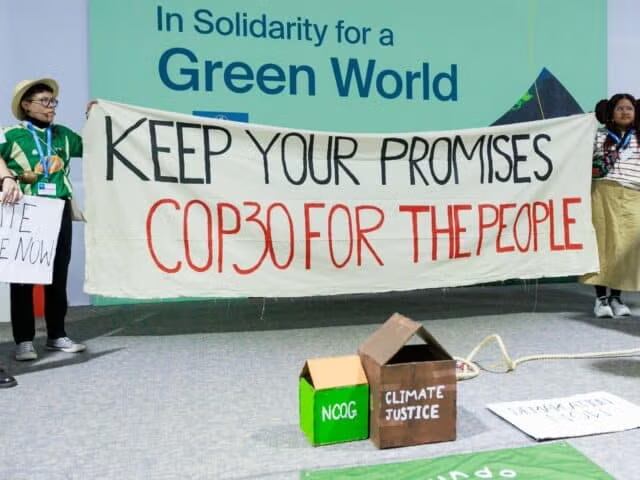
Action titled “COP30 Promises”. These forums need to be reclaimed! We must strip away industry influence, put human rights at the centre and make outcomes binding. (Photo: UN Climate Change via Flickr)
In 1992, my then 12-year-old daughter Severn pleaded with adult delegates at the Earth Summit in Rio de Janeiro, Brazil, to stop breaking the world. Thirty-three years later we’re still negotiating — and burning fossil fuels at record levels.
For the past 30 years, global representatives have gathered for United Nations Conference of the Parties (COP) climate summits, promising solutions. But political inaction continues to drive worsening climate disasters.
It’s hard not to be cynical. The COP process has become a theatre of contradiction. Recent summits have been hosted by petrostates and financed by polluters. Fossil fuel lobbyists attended COP28 and COP29 in greater numbers — 2,456 at COP28 and 1,800 at COP29 — than many national delegations.
Indigenous leadership is the most credible path forward.
Government leaders allow fine print to blunt big promises. At COP28 in Dubai, they urged a “transition away from fossil fuels,” but also recognized “transitional fuels” — the loophole many, including in Canada, use to justify “natural” gas expansion.
So why bother with COP30? Because this year’s event, in Belém, Brazil, can be historically significant if we let the Amazon and those who protect it shift the power. Brazil’s environment and climate change minister, Marina Silva, put it plainly: “I often say that society is doing its part, and science is doing its part. The ones who need to step up are the governments and companies.”
This conference is being billed as a “Nature COP,” a chance to braid climate, biodiversity and land goals in the world’s largest rainforest, where the stakes could not be higher. Indigenous leadership is the most credible path forward.
In spring, 180 organizations delivered a letter to the COP30 presidency calling for a halt to oil and gas expansion in the Amazon, echoing Amazonian Indigenous nations’ declarations. A few months later, the Inter-American Court of Human Rights affirmed that governments have a legal obligation to protect human rights in the face of the climate emergency.
People in the Amazon are already living through the crisis — long, punishing droughts and forest fires are threatening river ecosystems, cutting off transport and putting food security and health at risk. They’ve organized massive demonstrations to demand protection and a seat at the negotiating table.
Canada must decide what role to play in this moral drama.
This year will also mark a decade since the Paris Agreement, a major achievement of COP21. It was meant to motivate governments to set and meet ambitious climate targets. Global pledges have already failed to keep us below 1.5 C of warming, beyond which there’s no going back to the stability of the past.
Canada must decide what role to play in this moral drama. Prime Minister Mark Carney won’t endorse greenhouse gas targets, instead focusing on “results, not objectives.” But you can’t achieve results without clear objectives, timelines and accountability. If our government keeps greenlighting pipelines while sidelining targets, “results” will be measured in fires, floods and lost futures.
Energy policy must follow science. This means ending fossil fuel projects and scaling renewables quickly to replace them. Real climate governance means reforming laws, regulations and public finance, so climate goals actually yield results. Trade and investment deals shouldn’t be allowed to undermine climate progress, and every line in Canada’s budget should support a clear path to decarbonization.
If COP30 is to mean anything, we must heed Indigenous leadership, as they understand that the fate of the forest is our fate. We must finally empower those who have safeguarded Earth all along. True climate leadership at COP30 means setting a time-bound plan to end fossil fuel expansion, supporting Indigenous-led energy transitions and committing fair contributions to global finance.
We must strip away industry influence, put human rights at the centre and make outcomes binding.
The COP process is flawed and rife with failures. But it’s one of the few spaces where civil society, youth, scientists and Indigenous leaders can confront power face-to-face. This matters. We desperately need more global collaboration when multilateralism is threatened and authoritarianism is rising. We need international solidarity to push back against the wave of nationalism.
These forums need to be reclaimed! We must strip away industry influence, put human rights at the centre and make outcomes binding. If COP30 can deliver this type of necessary action, it will be remembered as a new beginning.
Power should be given to those who protect the forest, and costs to those who profit from its destruction. Power to the front-line movements fighting to make it so!
David Suzuki

David Suzuki, Co-Founder of the David Suzuki Foundation, is an award-winning scientist, environmentalist and broadcaster. David is renowned for his radio and television programs that explain the complexities of the natural sciences in a compelling, easily understood way.
Education
As a geneticist. David graduated from Amherst College (Massachusetts) in 1958 with an Honours BA in Biology, followed by a Ph.D. in Zoology from the University of Chicago in 1961. He held a research associateship in the Biology Division of Tennessee’s Oak Ridge National Lab (1961 – 62), was an Assistant Professor in Genetics at the University of Alberta (1962 – 63), and since then has been a faculty member of the University of British Columbia. He is now Professor Emeritus at UBC.
Awards
In 1972, he was awarded the E.W.R. Steacie Memorial Fellowship for the outstanding research scientist in Canada under the age of 35 and held it for three years. He has won numerous academic awards and holds 25 honourary degrees in Canada, the U.S. and Australia. He was elected to the Royal Society of Canada and is a Companion of the Order of Canada. Dr. Suzuki has written 52 books, including 19 for children. His 1976 textbook An Introduction to Genetic Analysis(with A.J.F. Griffiths), remains the most widely used genetics text book in the U.S.and has been translated into Italian, Spanish, Greek, Indonesian, Arabic, French and German.
My Blog Posts