

Bridging Place and Policy: Student Geography Research from the 2025 Conference at TRU
This is a long overdue post that is still timely, and the only thing that might suffer from writing it this late is my reputation, as I really wanted to feature the undergraduate students who engaged with these topics as soon as I saw their academic posters. What am I talking about? The “Bridging”-themed 66th Annual Meeting of the Western Division of the Canadian Association of Geographers (WDCAG), held March 6–8, 2025, at Thompson Rivers University.
I was at the second Livable Cities conference in February 2025, where I ran into professor Tom Waldichuk, who asked me to volunteer at the WDCAG 2025 conference. I took Tom’s Rural-Urban Fringe course a few years ago. It was my second-to-last course before graduating as a very mature student from the University of Toronto with an Honours BA in Economics and Geography. I am glad he asked me because I really do love the work of geography departments. I love cities, and geography covers everything I want to learn about them.
This love for cities clearly translates into my volunteer work with Transition Kamloops and the groups we collaborate with. That is why I asked Tom, and professor Patrick Buckley from Washington State University, if I could share some of their students’ academic posters with Transition Kamloops members. The following academic posters are reprinted with permission from the students and their supervising professors.
Click here to see the full poster: Urban Growth Across the Border (Dettman, Kuester)pdf
I found the poster Urban growth across the border: A tale of two cities (Dettman & Kuester, 2025) especially timely given recent debates in Kamloops about the future of Agricultural Land Reserve (ALR). In April 2024, Councillor Mike O’Reilly raised the idea of reviewing whether some land currently in the ALR should be opened for residential development as a response to the housing crisis. That discussion led Council to invite the Agricultural Land Commission to present on its mandate and the role of the ALR, which they did at a Regular Meeting of Council on July 16, 2024. During Public Inquiries on Matters Relating to the Agenda, Transition Kamloops requested that Council direct City staff to complete a lifecycle cost analysis comparing the long-term taxpayer costs of densification within the existing urban area with urban expansion through low-density development on land proposed for withdrawal from the Agricultural Land Reserve, including infrastructure and ongoing maintenance costs, before any changes to ALR land are considered. In that context, student research comparing land-use policy across jurisdictions underscores an important point: housing affordability pressures do not require sacrificing agricultural land. The poster highlights how density and compact urban growth can accommodate population growth while preserving farmland, food security, and long-term municipal sustainability (Dettman & Kuester, 2025).
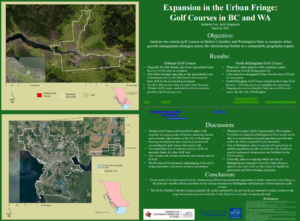
Click here to see the full poster: Expansion in the Urban Fringe (Fox, Jorgensen)
Expansion in the urban fringe: Golf courses in British Columbia and Washington State examines how land-use governance shapes development outcomes at the rural–urban fringe (Fox & Jorgensen, 2025). When farmland protections can be overridden politically, cities are more likely to expand outward. Where growth is governed by clear, long-term planning frameworks, expansion is slower, more deliberate, and harder to justify.
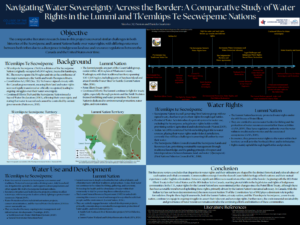
Click here to see the full poster: Navigating Water Sovereignty Across the Border (Denton, Guariento)
Another poster provides important context for how we think about water while cities continue to plan and make decisions. Navigating water sovereignty across the border: A comparative study of water rights in the Lummi and Tk’emlúps te Secwépemc Nations (Denton & Guariento, 2025) examines how colonial legal frameworks on either side of the Canada–U.S. border shape the recognition and exercise of Indigenous water rights. The research finds that, despite different legal contexts, both nations continue to face persistent challenges in asserting their inherent water rights, with water governance and environmental sustainability remaining unresolved policy issues.

Click here to see the full poster: Tree Equity Mapping in Kamloops (Tadic)
This next academic poster, Tree equity mapping in Kamloops, British Columbia: Canopy density and income correlation (Tadić, 2025), finds a small positive correlation between individual average income and urban tree canopy density. Matija’s research confirms what the City’s own Extreme Heat Response Plan finds, which is that urban tree canopy is essential for cooling, public health, and climate resilience. While the poster finds only a weak correlation between income and tree canopy, it reinforces the City’s recognition that canopy distribution is shaped by planning decisions, land use, and the built environment rather than socioeconomic factors alone.
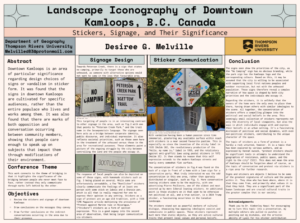
Click here to see the full poster: Landscape Iconography of Downtown Kamloops (Melville)
The last academic poster which brings it all together for me is Landscape iconography of downtown Kamloops, B.C., Canada: Stickers, signage, and their significance (Melville, 2025) where the author examines how informal signage and stickers reflect power, resistance, and communication in public space. How moving is this simple phrase from Desiree: “This work connects to the theme of bridging in that it highlights the significance of the bridging between people who never meet face to face, rather instead they only communicate through marks left behind by the other” (Melville, 2025). The author so cleverly begins with the No Camping sign vis-à-vis a Xget’tem’ Trail sign, as we, so comfortably settled on unceded territories, have so much to say about how the space should be occupied, who belongs, and what norms they should conform to.
My other observation of the academic poster portion of the conference is the many professionals and academics who spent so much time with the undergraduate students discussing their findings and their presentation techniques. It was such an encouraging environment. And a big shoutout to prof. Waldichuk and prof. Buckley for questioning how I would present their students’ work, ensuring it would be viewed with academic curiosity and care.
There were many more posters that I could have included here as they touched on so many topics that are of personal interest to me but I will end here. I encourage you to peruse the Conference guide and explore the fascinating work that goes on in and around our beloved city. And when I say “our” I mean it with the utmost humility and a desire to contribute to a place that serves each person and our work is grounded in dignity and care.
Thank you, Tom, for inviting me to participate in the WDCAG 2025 conference as a volunteer. Thank you to the students for sharing your ideas, for being curious, and for reminding us how brilliant you are and how much you have to contribute to the work of building a more just and caring place. Happy 2026.
Feature image: Authors of Urban growth across the border: A tale of two cities presenting their findings to Elwira at the WDCAG 2025 conference.
Transition Kamloops

Transition Kamloops is a volunteer-driven, registered not-for-profit society focused on increasing local resilience and self-sufficiency in food, water, energy, culture and wellness. We emphasize a local economy, healthy ecosystems, and grassroots community building, while reducing our dependence on fossil fuels. We believe in a better way: a community that sustains life in all its diversity, strives for equality and justice and invests in the future.
Transition Kamloops recognizes that we are living on Secwépemcul’ecw—land that was never ceded to settlers, and continues to be home to vibrant Indigenous cultures, languages, and traditions. We acknowledge the impact of colonization, forced displacement, and ongoing struggles faced by Indigenous peoples. We commit to listening, learning, and building positive relationships with Indigenous communities as we work towards reconciliation.
My Blog Posts