
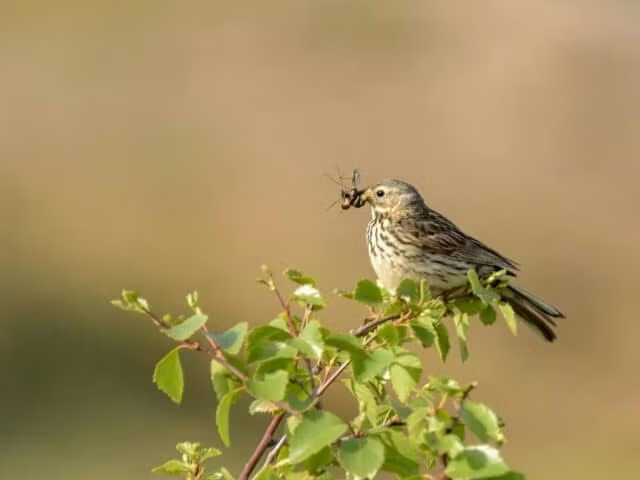
Birds and insects are disappearing. That should worry us all
A world without insects and birds is unimaginable. Every terrestrial ecosystem would collapse without insects and countless species would go extinct.
Rachel Carson’s 1962 book Silent Spring should have been a wakeup call to the world. It opened my eyes — and it’s a big part of the reason I started questioning my career in genetics and decided to devote my life to environmental causes. It exposed the limitations of reductionist Western science and showed how our actions can create unintended consequences throughout interconnected natural systems.
Yet, it drew — and still draws — tremendous, often sexist, backlash from mainstream scientists, industry and media. It cast doubt on the wisdom of awarding someone like Paul Müller a Nobel Prize in 1948. The Swiss chemist had discovered DDT, a powerful insecticide credited with reducing the incidence of malaria. While its use on disease-carrying mosquitoes undeniable saved human lives, it also led to the deaths of millions of bald eagles, osprey, pelicans and other birds.
What have we learned in the 64 years since Silent Spring was published? Apparently not much.
Part of the problem, as Carson reported, is that studying phenomena in labs, flasks and growth chambers doesn’t mimic real world conditions, where wind and rain carry molecules into air, soil and waterways, causing effects that can take months or years to show up, such as weakened eggshells.
Powerful insecticides don’t just kill target insects and, as geneticists know, the “pests” targeted can mutate over time to resist pesticides. Scientists also discovered another important factor: biomagnification. This occurs when toxins become increasingly concentrated throughout the food chain. When birds, bats, lizards and other animals eat insects exposed to chemical poisons, the pesticides accumulate in them and then in other animals, including humans, that eat the birds and other creatures.
What have we learned in the 64 years since Silent Spring was published? Apparently not much. Bird populations are declining catastrophically, as are insects. Scientists point to widespread insecticide use and a heating climate as likely factors.
A recent study in the journal Science analyzed 261 bird species in North America and found that half “showed significant declines from 1987 to 2021, and a quarter showed accelerating declines. Hotspots of accelerating abundance decline were located in regions with high-intensity agriculture (high cropland area, fertilizer use, or pesticide use).”
When are we going to realize everything is connected? Insecticides are a crazy way to “control” pests.
A 2019 study by Georgetown University ornithologist and dean Peter P. Marra and other scientists found bird numbers in the United States and Canada fell by 2.9 billion, or 29 per cent, since 1970. Another study found bird declines were prevalent among those that ate insects — which is most of them — whereas some that don’t rely on insects increased in number. The Science study found many bird species living in forests were stable or increasing.
Marra, who specializes in bird populations, said the study illustrates the folly of society’s focus on constant economic growth.
“The American dream turns into the American nightmare as we start to look at what we’re doing to biodiversity and systems that we depend on as humans,” he told the New York Times.
Besides insect declines, driven largely by pesticide use, birds face numerous other threats, including habitat loss, collisions with building windows and predation by cats.
When are we going to realize everything is connected? Insecticides are a crazy way to “control” pests. Insects are the most numerous, diverse, abundant and therefore important group of terrestrial animals on the planet. They not only feed a huge number of species — from fish, frogs, reptiles and mammals to birds and even plants — they are also critical for pollination and food production. And they control many other insects by predation.
A world without humans would be covered in forests and greenery and filled with diverse, abundant species.
We think spraying powerful insecticides to eliminate a tiny fraction that are “pests” to us (mosquitoes, fleas, potato beetles or cotton borers) is sound management. It’s a bit like eliminating murder in a city by killing everybody.
A world without insects and birds is unimaginable. Every terrestrial ecosystem would collapse without insects and countless species would go extinct.
We’ve reached a point where the primary life form the planet could do without is us. A world without humans would be covered in forests and greenery and filled with diverse, abundant species. That’s only because we as a species have become too numerous, technologically powerful and demanding to be a benign rather than negative force on this fragile planet. We must remember that we are part of nature before we destroy everything that keeps us alive and healthy.
David Suzuki

David Suzuki, Co-Founder of the David Suzuki Foundation, is an award-winning scientist, environmentalist and broadcaster. David is renowned for his radio and television programs that explain the complexities of the natural sciences in a compelling, easily understood way.
Education
As a geneticist. David graduated from Amherst College (Massachusetts) in 1958 with an Honours BA in Biology, followed by a Ph.D. in Zoology from the University of Chicago in 1961. He held a research associateship in the Biology Division of Tennessee’s Oak Ridge National Lab (1961 – 62), was an Assistant Professor in Genetics at the University of Alberta (1962 – 63), and since then has been a faculty member of the University of British Columbia. He is now Professor Emeritus at UBC.
Awards
In 1972, he was awarded the E.W.R. Steacie Memorial Fellowship for the outstanding research scientist in Canada under the age of 35 and held it for three years. He has won numerous academic awards and holds 25 honourary degrees in Canada, the U.S. and Australia. He was elected to the Royal Society of Canada and is a Companion of the Order of Canada. Dr. Suzuki has written 52 books, including 19 for children. His 1976 textbook An Introduction to Genetic Analysis(with A.J.F. Griffiths), remains the most widely used genetics text book in the U.S.and has been translated into Italian, Spanish, Greek, Indonesian, Arabic, French and German.
My Blog Posts