
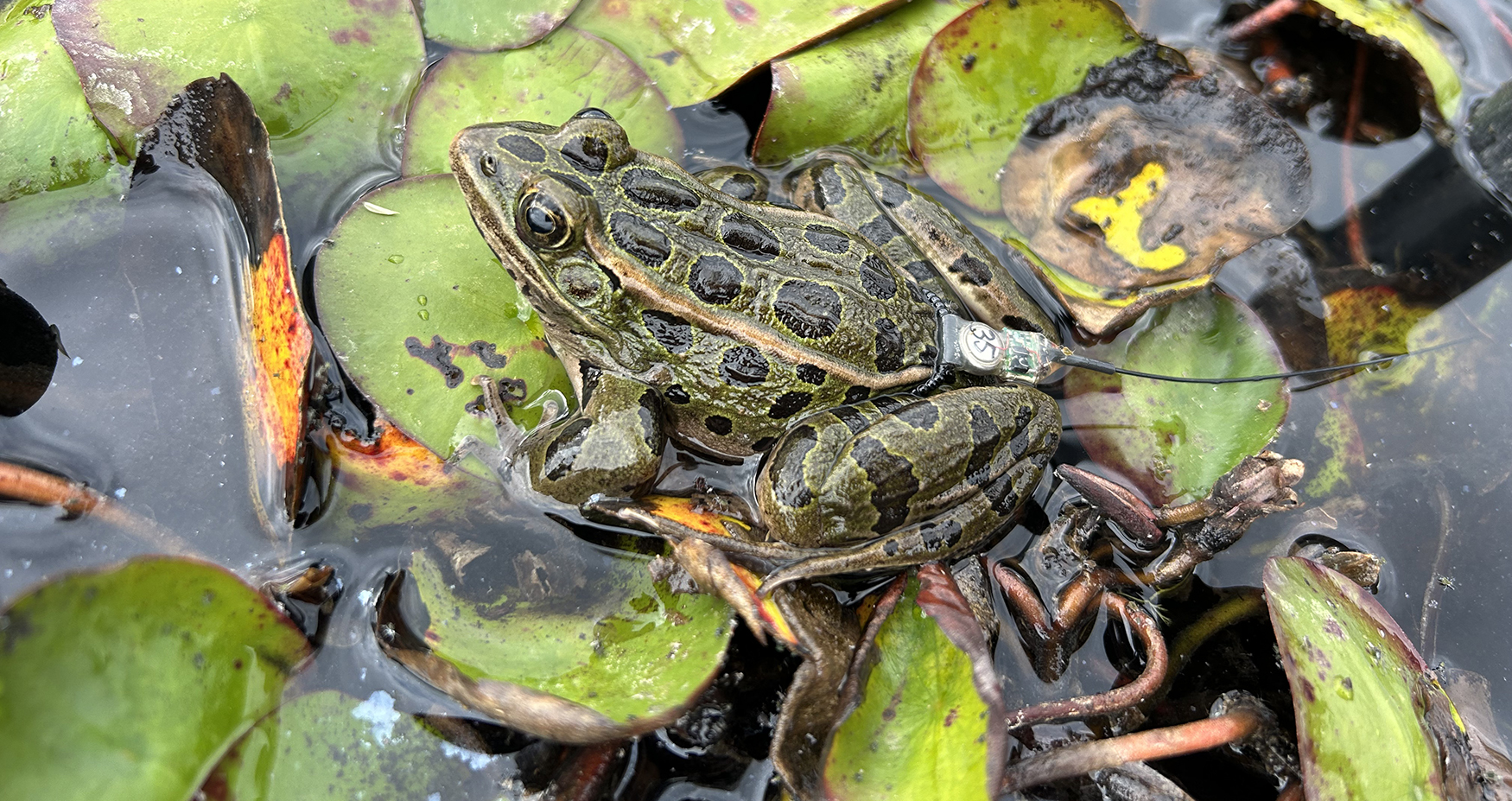
Master’s research explores how endangered frogs and agriculture can coexist
A Thompson Rivers University (TRU) master’s student is shedding new light on how habitat use patterns may be placing one of Canada’s most endangered amphibians at risk — and how thoughtful land management could help ensure its survival alongside agriculture.
Blaire Smith, a graduate student in the Faculty of Science, is studying northern leopard frogs (Lithobates pipiens) in British Columbia’s Creston Valley Wildlife Management Area. Her research focuses on how the frogs move across the landscape during key times of year, and whether those movements bring them into conflict with farming practices.
Under the supervision of TRU faculty member Dr. Karl Larsen and adjunct faculty member Dr. Leigh Anne Isaac in the Faculty of Science’s Natural Resource Science department, Smith’s work supports conservation efforts for a species now confined to a single remaining stronghold in the province.
Smith’s research reflects TRU’s commitment to community impact and sustainability, applying science to real-world challenges and supporting the stewardship of local ecosystems.
Studying B.C.’s last northern leopard frogs
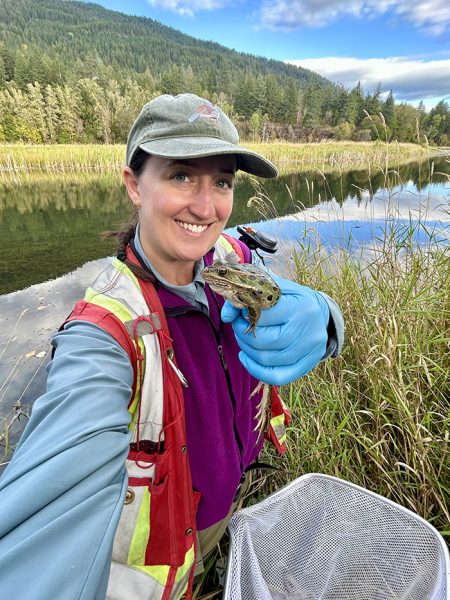
Master of Science in Environmental Science student Blaire Smith holds a northern leopard frog during her graduate fieldwork in BC’s Creston Valley Wildlife Management Area.
The population Smith is studying is critically important. Northern leopard frogs are listed as endangered in both B.C. and Canada, and the Creston Valley frogs represent the last remaining northern leopard frog population in the province. Even more significantly, they belong to a distinct Rocky Mountain genetic group that has disappeared everywhere else — making this the final surviving Rocky Mountain population of the species in Canada.
Larsen says the work carries both hope and concern.
“I have found this project bittersweet in some ways: as a kid I recall always seeing leopard frogs in the Columbia River valley — they were a regular part of my summer adventures. Now, this race of the frog is down to one single population in Canada. So, it’s great to see interest and support in Blaire’s work, but at the same time, it’s very troubling that we’re on the edge of losing this once-abundant animal.”
Smith’s fieldwork takes place on the unceded and traditional lands of the Yaqan nukiy within the Ktunaxa Nation.
“I am grateful for the opportunity to study wildlife that the Nation has stewarded since time immemorial,” says Smith.
Her research is supported by a wide network of collaborators, including the BC Northern Leopard Frog Recovery Team, Creston Valley Wildlife Management Area, Environment and Climate Change Canada, the Fish and Wildlife Compensation Program, the Ministry of Water, Land and Resource Stewardship, Mitacs, the Nature Conservancy of Canada and numerous field technicians.
Asking where frogs go — and why it matters
Smith’s interest in the species dates back to 2018, when she first began working with northern leopard frogs.
“Since then, the frogs have hopped their way into my heart,” she says. “Spending time with B.C.’s last remaining population has made me very passionate about helping them survive and recover.”
Her project was sparked by a practical conservation question from the Nature Conservancy of Canada, which manages land in the Creston area for both wildlife and farming values.
“They asked, ‘What can we do differently to support northern leopard frogs on our land?’ That question really launched this research.”
In simple terms, Smith’s thesis asks where northern leopard frogs spend time during the summer and fall, what habitat characteristics they are selecting and whether those choices overlap with agricultural activity.
“Do those overlaps put the frogs in jeopardy?” asks Smith. “And if they do, can we develop best management practices that allow the frogs to persist and recover?”
Following frogs across the landscape
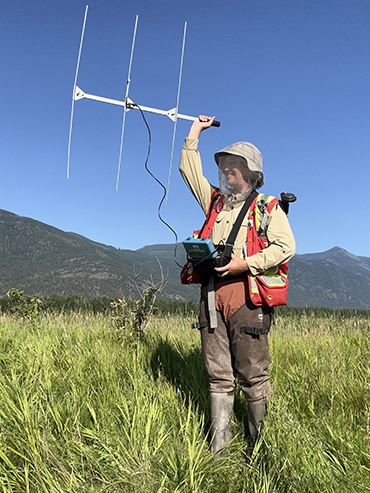
Smith tracks northern leopard frogs’ movements between habitats using radio telemetry.
Northern leopard frogs depend on three distinct habitat types throughout the year: shallow, warm wetlands for breeding; moist upland areas like grasses and meadows for summer foraging; and deeper, well-oxygenated water bodies where they overwinter.
Because they rely on all three, connectivity between habitats is essential.
“If even one of these habitats is degraded or lost, the frogs may struggle to complete their life cycle,” Smith explains.
To understand how frogs move between these habitats, Smith uses radio telemetry. Each frog wears a tiny belt with a lightweight radio transmitter, allowing her to locate individuals every few days and map their movements.
“When I find a frog, I record habitat details like temperature, vegetation cover, and soil moisture,” she says. “I also collect data from a nearby random site so I can compare what frogs are selecting versus what’s available.”
One of the surprises from Smith’s 2025 field season wasn’t where the frogs were going, but when.
“In past years, frogs typically reached their overwintering sites in late August,” she says. “This year, some migrated in early July — about six weeks sooner than expected.”
That shift could be linked to climate-related changes, such as wetlands drying earlier in the season. Smith has completed her data collection, and analysis is now underway.
Where frogs and farming intersect
While the full picture is still emerging, Smith already knows that part of the frogs’ annual migration takes them through active agricultural fields.
“That means their seasonal movements may put them directly in the path of farming operations,” she says.
In landscapes where wetlands, ditches and moist field margins sit next to crops, frogs may follow these wetter corridors as they move between summer habitat and overwintering sites — bringing them into areas where heavy equipment, harvesting and routine fieldwork are underway.
August appears to be a particularly sensitive time, as crop harvesting often coincides with the frogs’ migration period. Identifying how and when those overlaps occur is a key goal of Smith’s ongoing analysis.
“I hope to identify management solutions that work for both wildlife and agriculture,” she says.
A hopeful path forward
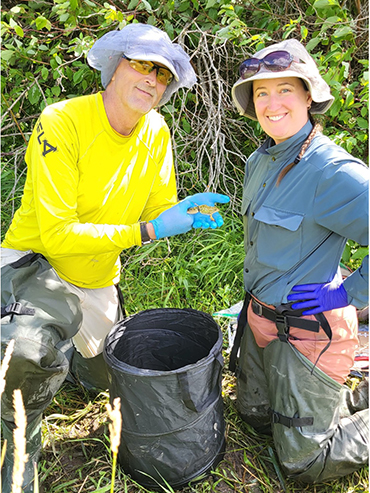
Dr. Karl Larsen and Blaire Smith apply transmitters to northern leopard frogs.
Despite the challenges facing the species, Smith remains optimistic.
“What gives me hope is that this population is still here,” she says. “Every other Rocky Mountain population of northern leopard frogs has disappeared, yet this one has managed to persist.”
She also sees hope in local interest and buy-in — including from people who live and work near the wetlands.
“I have had really positive feedback from people in the Creston area,” she says, adding that many locals are proud the population is still here. She recalls one local farmer who has followed her work closely — even texting her photos when he spots a frog on his property.
She believes studying this population could provide insights that help support other at-risk amphibians.
Smith also draws encouragement from the collaboration behind the recovery effort — and the real possibility that findings can turn into action.
“Biologists, researchers, field technicians, governments, conservation groups, zoos and aquariums are all working toward the same goal,” she says. “Seeing that level of cooperation shows me that solutions are possible.”
For Smith, some of the most powerful moments come during spring fieldwork, when she listens for calling males at dusk.
“Hearing northern leopard frogs calling in that soundscape — when elsewhere in the province they are silent — is a reminder of why this work matters,” she says.
As her research continues, Smith hopes her findings will help ensure a future where frogs and farmers can thrive side by side.





Thompson Rivers University is leading in sustainability. Learn more about TRU’s contributions to the UN Sustainable Development Goals.