
Jane Goodall challenged the divide between human and non-human animalsls
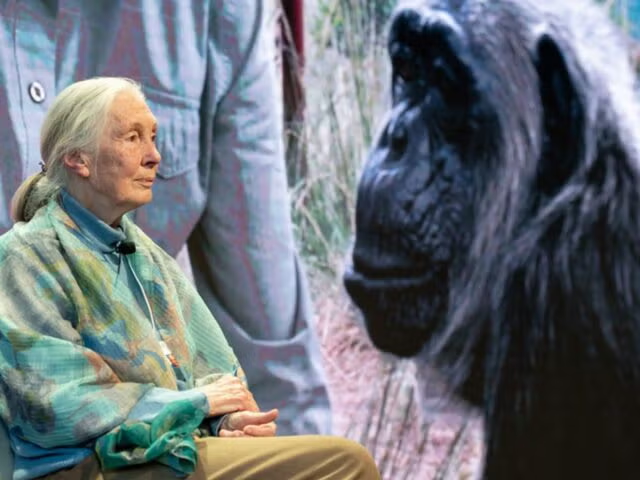
Jane Goodall at the World Economic Forum in 2019. She should be remembered as a scientist and an agent of change.
Conservationists worldwide face the new year with a significant gap left by Jane Goodall’s death.
Goodall was a tireless voice for wildlife and habitat protection. She refused to see chimpanzees as objects, recognizing them instead as fellow beings. Their acceptance of her granted unparalleled access to their world.
But her impact went further. Her findings helped topple imposed boundaries between human and non-human animals. Scientists had long believed that only humans used tools. After Goodall observed chimps using sticks to fish for termites, her mentor Louis Leakey sent a telegram, stating, “Now we must redefine tool, redefine man, or accept chimpanzees as humans.”
Option 2 prevailed. After chimps’ tool use was verified, scientists proposed a new distinction: non-human animals could use tools but couldn’t make them.
Empathy and a sense of the future have also been disproven as human-only.
It was only a matter of time until chimps were observed stripping and shaping termite sticks. Crows manufacture tools from leaves, among other examples. Claims were then made that only humans have culture (social learning across generations). But meerkats teach their young to hunt, and orca pods have regionally specific hunting strategies and social organization. The list goes on.
Language has been held up as dividing line, although efforts are continually underway to crack other creatures’ codes, from bee dances that map out pollen locations to whale songs that travel kilometres under the ocean’s surface. Language syntax and complexity may differ, but most living beings share the ability to communicate.
The claim that self-awareness is solely human has also been grudgingly discarded, after numerous species “passed” the “mirror self-recognition test” (starting with chimps in 1970).
Empathy and a sense of the future have also been disproven as human-only. Most people with pet dogs can attest to empathy during spells of sadness and have seen the excitement generated by a pending walk. The ability to problem solve, once thought a solely human domain, has been observed in rats, among other species.
Humans are unique. So are other animals. Goodall’s work ruptured the social construction of apex humans.
Three claims elevating humans above other animals are articulated today to varying degrees: the human abilities to create art, develop technology and abstract from self.
Yet is not the nest of a bower bird or a whale song a kind of art? And while human technology is astounding (medical technology has equipped us with the ability to save lives and green technology has allowed us to capture energy from the sun and wind), some technologies — such as the polluting, climate-altering internal-combustion engine or a logging machine able to fell multiple trees in one pass — are devastating the planet we depend on. (Meanwhile, technology is also used to create vehicles to vacate the planet should we destroy it.) It can be difficult to frame our technological prowess entirely as a beacon of intelligence.
As for a species’ ability to abstract from itself, how can we possibly know what goes on in the minds of other creatures when most studies, unlike Goodall’s, involve taking animals out of their worlds, placing them in cages and measuring them against human standards?
Humans are unique. So are other animals. Goodall’s work ruptured the social construction of apex humans. We’ve been struggling to patch it ever since. How else can we justify our mass mistreatment of fellow animals?
Jane Goodall should be remembered as a scientist and an agent of change.
As we move into the new year, we need more ruptures in mainstream thinking. It’s the cracks that let the light in. Science has shown that we’re kin with all living things, branches on an evolutionary tree. As Barbara Noske advocates in her book Humans and Other Animals, we must recognize the discontinuity between ourselves and other animals as horizontal, not vertical.
In 2020, the late Sen. Murray Sinclair introduced legislation — the Jane Goodall Act — to prohibit common forms of captivity for elephants and great apes. The Senate passed a version (Bill S-15) in the last session of Parliament. Unfortunately, it didn’t make it through the House of Commons before the 2025 election. It would be a fitting tribute to Goodall’s legacy for the government to reintroduce it and for Parliament to at last pass it into law.
Jane Goodall should be remembered as a scientist and an agent of change. Let’s hope that 2026 brings more compassionate voices like hers to collapse harmful systems and bring about a gentler, healthier world — for humans and all our animal relatives.
David Suzuki

David Suzuki, Co-Founder of the David Suzuki Foundation, is an award-winning scientist, environmentalist and broadcaster. David is renowned for his radio and television programs that explain the complexities of the natural sciences in a compelling, easily understood way.
Education
As a geneticist. David graduated from Amherst College (Massachusetts) in 1958 with an Honours BA in Biology, followed by a Ph.D. in Zoology from the University of Chicago in 1961. He held a research associateship in the Biology Division of Tennessee’s Oak Ridge National Lab (1961 – 62), was an Assistant Professor in Genetics at the University of Alberta (1962 – 63), and since then has been a faculty member of the University of British Columbia. He is now Professor Emeritus at UBC.
Awards
In 1972, he was awarded the E.W.R. Steacie Memorial Fellowship for the outstanding research scientist in Canada under the age of 35 and held it for three years. He has won numerous academic awards and holds 25 honourary degrees in Canada, the U.S. and Australia. He was elected to the Royal Society of Canada and is a Companion of the Order of Canada. Dr. Suzuki has written 52 books, including 19 for children. His 1976 textbook An Introduction to Genetic Analysis(with A.J.F. Griffiths), remains the most widely used genetics text book in the U.S.and has been translated into Italian, Spanish, Greek, Indonesian, Arabic, French and German.
My Blog Posts