
It’s time to loosen billionaires’ stranglehold on humanity
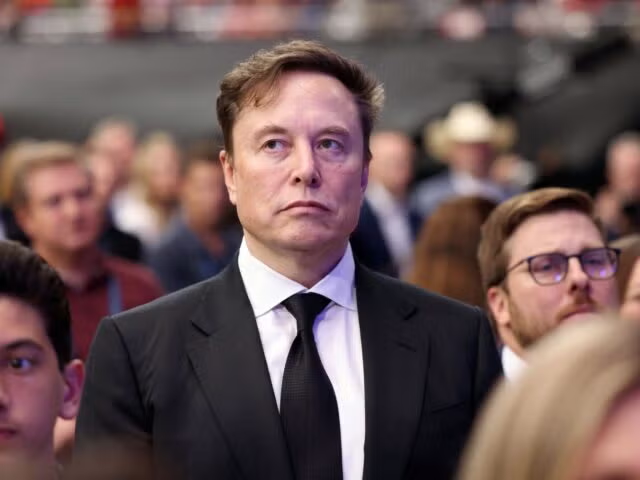
Elon Musk alone could solve many of the world’s most serious problems and still remain obscenely rich — if he weren’t … well, Elon Musk. (Photo: Gage Skidmore via Flickr)
Economic reporting could mislead one into believing that budget deficits are the most important challenge governments face. They’re used as an excuse to curtail spending on necessary benefits, including health care, education, social security, climate action and more. Is it true that countries such as Canada and the United States can’t afford these services?
A U.S. study referenced by Guardian writer George Monbiot shows that the very rich consider budget deficits to be the top issue, with climate action at the bottom of the list.
“They were far more likely to insist that social security and federal healthcare should be cut, and far less likely to believe that the unemployed should have a ‘decent standard of living’, or that there should be more regulation of oil companies, banks and health insurers,” Monbiot writes. “They were fiercely opposed to redistribution.”
Clearly, these ultra-wealthy think differently than most of us. So why do so many people accept their reasoning about deficits and affordability?
They want to protect their interests. A recent Oxfam study found that, over the past year, “The 10 richest U.S. billionaires got $698 billion wealthier, and the arrival of the world’s first trillionaire grew more imminent.” As Monbiot writes, “That money alone, the increment in the wealth of 10 people, is almost 10 times the annual amount required to end extreme poverty worldwide.”
Monbiot’s column was partly in response to billionaire Bill Gates’s recent essay arguing that money would be better spent on poverty, disease and climate adaptation than on cutting greenhouse gas emissions. It also comes in the wake of news that Elon Musk is about to become the world’s first trillionaire. (To get an idea of how much that is, counting a trillion seconds would take 32,000 years.)
Clearly, these ultra-wealthy think differently than most of us. So why do so many people accept their reasoning about deficits and affordability? When it comes to politics, Monbiot notes, money talks. “The richer they become, the more they can bend the state and economic system to their will, ensuring that they become richer still.”
Taxing the super affluent at rates that would still leave them with enough to maintain lavish lifestyles could generate enough money to resolve many societal issues, from health to hunger to global heating.
Or, as Oxfam states, “Rapidly increasing corporate concentration in recent decades has given large firms more political influence and market power — and thus more power to directly shape people’s lives, including through shaping policy and setting wages, working conditions, and prices.”
We’re seeing a blatant example in the U.S., where the current administration is lowering taxes for the rich while cutting essential services for the middle and working classes, along with climate change policies and more. Meanwhile, U.S. President Donald Trump threw a lavish Great Gatsby–themed party at Mar-a-Lago for wealthy planet-haters including Australia’s Gina Rhinehart (who has coal-mining interests in Alberta) while ordinary people struggled to feed themselves during a government shutdown.
Taxing the super affluent at rates that would still leave them with enough to maintain lavish lifestyles could generate enough money to resolve many societal issues, from health to hunger to global heating. Despite relentless propaganda and distractions from billionaire-owned media outlets and social media platforms, many people are starting to see through the smoke. A recent YouGov poll found 69 per cent of American adults (including 40 per cent of Republicans!) support raising taxes on millionaires and corporations.
Support was also high for free child care (66 per cent), rent freezes (65 per cent), free public transit (53 per cent) and increasing minimum wages (56 per cent).
We could resolve most or all these problems simply by making the mega-rich pay their fair share.
Elon Musk alone could solve many of the world’s most serious problems and still remain obscenely rich — if he weren’t … well, Elon Musk. Oxfam reports that if the world’s 10 richest people lost 99 per cent of their wealth, they’d still be billionaires!
It’s hard to imagine that anybody would be worth billions, no matter how hard they worked or how much they contributed to society. The truth is, most don’t earn it. Oxfam points out that “Sixty percent of billionaire wealth is now derived from inheritance, monopoly power or crony connections.”
Humanity is facing numerous existential crises, from poverty and hunger to species extinction and climate disruption. We could resolve most or all these problems simply by making the mega-rich pay their fair share. But they hold the levers of power, though media ownership, political influence and having the time and resources to manipulate public opinion.
It’s up to us — the vast majority — to demand change.
David Suzuki

David Suzuki, Co-Founder of the David Suzuki Foundation, is an award-winning scientist, environmentalist and broadcaster. David is renowned for his radio and television programs that explain the complexities of the natural sciences in a compelling, easily understood way.
Education
As a geneticist. David graduated from Amherst College (Massachusetts) in 1958 with an Honours BA in Biology, followed by a Ph.D. in Zoology from the University of Chicago in 1961. He held a research associateship in the Biology Division of Tennessee’s Oak Ridge National Lab (1961 – 62), was an Assistant Professor in Genetics at the University of Alberta (1962 – 63), and since then has been a faculty member of the University of British Columbia. He is now Professor Emeritus at UBC.
Awards
In 1972, he was awarded the E.W.R. Steacie Memorial Fellowship for the outstanding research scientist in Canada under the age of 35 and held it for three years. He has won numerous academic awards and holds 25 honourary degrees in Canada, the U.S. and Australia. He was elected to the Royal Society of Canada and is a Companion of the Order of Canada. Dr. Suzuki has written 52 books, including 19 for children. His 1976 textbook An Introduction to Genetic Analysis(with A.J.F. Griffiths), remains the most widely used genetics text book in the U.S.and has been translated into Italian, Spanish, Greek, Indonesian, Arabic, French and German.
My Blog Posts