
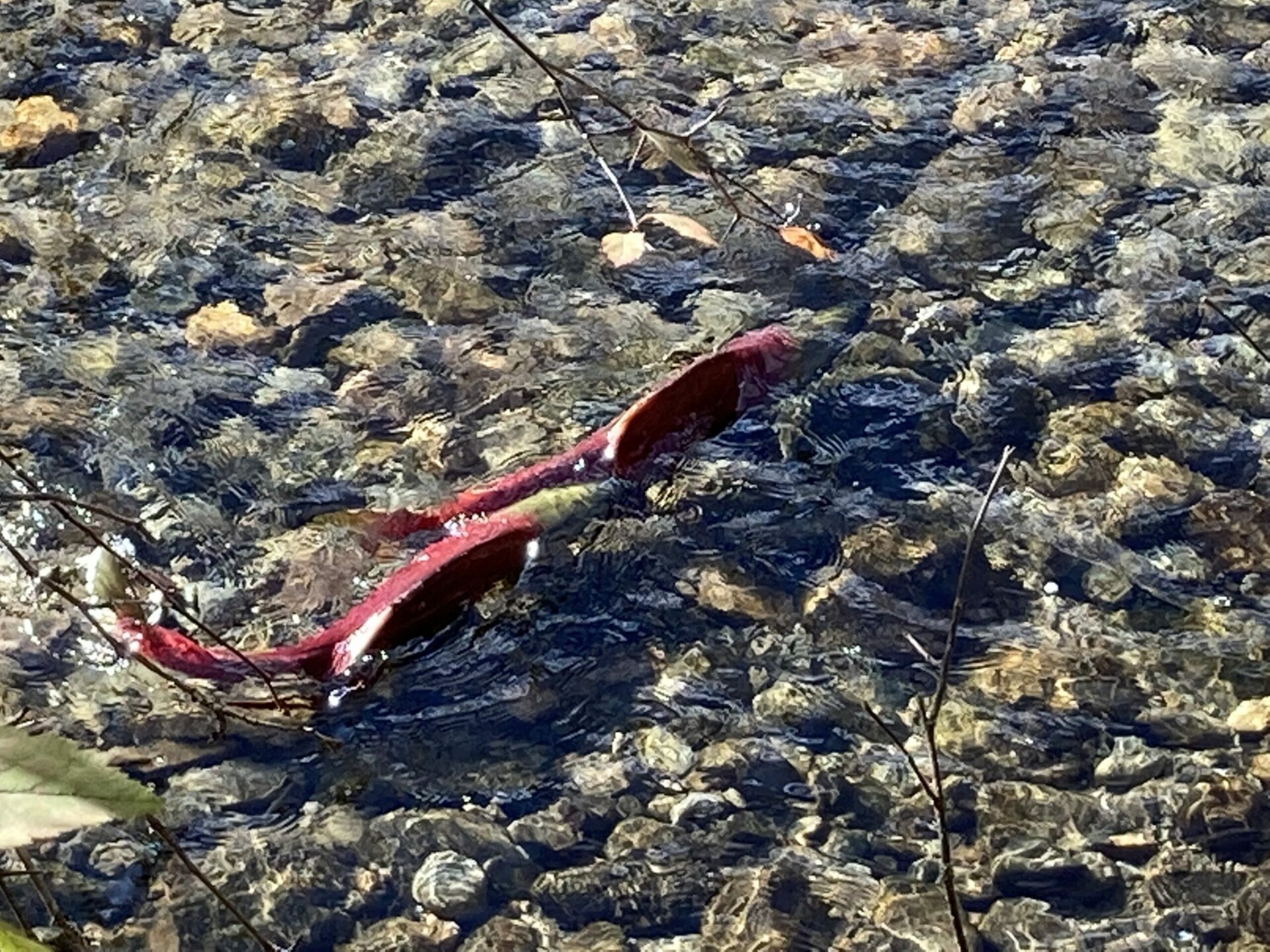
Thompson River watershed salmon run sees slight increase in 2025
Of the five Pacific salmon species in BC, four are documented to spawn within the Thompson River watershed (McPhail, 2007); pink salmon (Oncorhynchus gorbuscha), sockeye salmon (Oncorhynchus nerka), chinook salmon (Oncorhynchus tshawytscha), and coho salmon (Oncorhynchus kisutch) migrate from the ocean up treacherous rapids and fast currents to access their spawning grounds in this watershed.
Regionally, within the Thompson River and other watersheds associated with the Fraser River, brood runs (i.e., groups of salmon on their way to breed) of salmon species have had lower numbers resulting in stricter catch regulations in the past. Lower numbers are a result of a multitude of effects, which can include climate change, riparian zone removal (due to increased sedimentation and pollution), changes in water chemistry (i.e., temperature, conductivity, and/or pH), overfishing (poaching), and low survival rates of young juvenile fish heading to the ocean, among other factors. The result is that some of these species have been listed as at-risk and/or protected, including the interior Fraser population of coho salmon (BC CDC, 2025).
In 2025, a small change was observed in our regional runs, as a surge of sockeye, pink, and chinook salmon were recorded entering the mouth of the Fraser River (Pacific Salmon Foundation, 2025). This increase resulted in an opening for fishing in the area of this run (Fisheries and Oceans Canada [DFO], 2025). Though this is a positive for the region in general, salmon populations as a whole are still decreasing (Pacific Salmon Foundation, 2025).
The appearance of a good run of salmon in the Thompson River watershed has led many to hope for the return of a great fishery. However, there is still a lot to do to make this possible. Individuals, companies, municipalities, and other government bodies have much work to do to protect the fish and their habitat, and to regulate actions that may have an impact on our waterways. I believe that one day we will get consistent numbers back again, but I know it will take a while!
References
BC CDC. (2025). BC species & ecosystem explorer. Government of BC. Accessed online at: https://www2.gov.bc.ca/gov/content/environment/plants-animals-ecosystems/conservation-data-centre/explore-cdc-data/species-and-ecosystems-explorer
Fisheries and Oceans Canada (DFO). (2025). Region 3 – Thompson-Nicola: Recreational salmon fishing limits, opening and closures. Government of Canada. Accessed online at: Region 3 – Thompson-Nicola: Recreational salmon fishing limits, openings and closures | Pacific Region | Fisheries and Oceans Canada
McPhail, J. D. (2007). The Freshwater Fishes of British Columbia. University of Alberta Press.
Pacific Salmon Foundation. (2025). New report highlights salmon recovery in regions, but long-term declines persist. Accessed online at: https://psf.ca/news-media/new-report-highlights-salmon-recovery-in-some-regions-but-long-term-declines-persist/
Photo credit: Shelley McGuinness
Transition Kamloops

Transition Kamloops is a volunteer-driven, registered not-for-profit society focused on increasing local resilience and self-sufficiency in food, water, energy, culture and wellness. We emphasize a local economy, healthy ecosystems, and grassroots community building, while reducing our dependence on fossil fuels. We believe in a better way: a community that sustains life in all its diversity, strives for equality and justice and invests in the future.
Transition Kamloops recognizes that we are living on Secwépemcul’ecw—land that was never ceded to settlers, and continues to be home to vibrant Indigenous cultures, languages, and traditions. We acknowledge the impact of colonization, forced displacement, and ongoing struggles faced by Indigenous peoples. We commit to listening, learning, and building positive relationships with Indigenous communities as we work towards reconciliation.
My Blog Posts