
Expanding LNG will increase prices and pollution
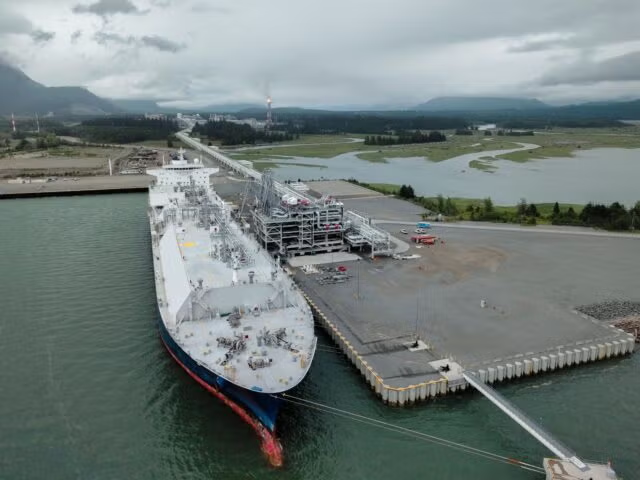
LNG carrier GasLog Glasgow at the Canada site in Kitimat, B.C. in June 2026. (Photo: LNG Canada )
Higher home heating prices. Pollution. Accelerating climate change. Water shortages. Indigenous rights violations. Who wants that? Apparently the obscenely profitable fossil fuel companies, and unimaginative, short-sighted governments banking on outdated ideas to shore up the economy.
A government is judged on the markers of our current economic system: job creation, economic growth, bearable tax and interest rates and provision of essential services. It must also focus on the three to five years until the next election.
That means “success” is often measured by illusory short-term gain. A quick but outdated and inefficient way to boost job creation and economic growth is to exploit and sell raw “resources,” mostly for export — especially through forestry, mining and fossil fuel development.
Has industry lived up to its LNG promises? A David Suzuki Foundation report concludes that it hasn’t and isn’t likely to.
This blinkered mindset has led to a growing push to expand production of fracked fossil gas (or liquefied “natural” gas, which is mostly the potent greenhouse gas methane), along with building infrastructure such as pipelines and ports. Governments, including British Columbia and Canada’s, often accept industry promises of money and jobs, and offer incentives including tax breaks, subsidies and infrastructure support.
Has industry lived up to its LNG promises? A David Suzuki Foundation report concludes that it hasn’t and isn’t likely to. “Running on Fumes: B.C. LNG’s Overhyped Promises, Risky Future and Public Costs” finds the fracked gas industry is plagued with many of the same issues and false promises as the mining industry: delays, under-delivery and tax regimes that undermine potential economic benefits.
Delays aren’t caused by red tape or regulation but by “investor decision-making and market conditions, a circumstance likely to worsen as a global supply glut deepens and decarbonization threatens the industry’s long-term outlook.”
With much of the infrastructure manufactured outside Canada, job creation also falls short.
The report finds tax policy changes have cut projected tax revenue in B.C. by 40 to 50 per cent for pipelines and LNG terminals. Additional incentives to lure more projects, including provincial sales tax exemptions, could wipe out most provincial gains. Municipal tax revenues are also not as promised: returns from LNG Canada’s construction period were just 25.8 per cent of estimates in the project’s environmental assessment application.
With much of the infrastructure manufactured outside Canada, job creation also falls short. “LNG Canada manufactured steel modules offshore that accounted for somewhere between 50 and 76 per cent of the direct impact it claimed it would have on Canadian GDP during construction.”
As well, “nearly 90 per cent of the LNG export capacity that appears to be moving forward is majority owned by multinational conglomerates and foreign state-owned oil companies, meaning that profits will likely be exported rather than reinvested within B.C. or Canada, creating both a structural dependency on volatile foreign markets and a persistent drain of wealth.” LNG Canada is a joint venture between Shell, Petronas (Malaysian government), PetroChina (Chinese government), Mitsubishi Corporation (Japanese-owned) and Kogas (South Korean government).
How does this affect consumers? “There is mounting evidence from the U.S., Australia and, increasingly, B.C. that growth in LNG export capacity has a tendency to raise domestic gas prices,” the report states.
Subsidized LNG, which our governments are going with, can delay or lock out more cost-effective and cleaner renewables.
The Institute for Energy Economics and Financial Analysis says gas prices more than doubled in Australia once the LNG industry took off. Prices also rose in the United States. That’s because LNG can often be sold for more in foreign markets, which means more gets exported, driving up domestic prices. Using Deloitte’s price increase estimate, the report finds the average residential gas bill in Vancouver could go up by $188.39 in 2026 and continue to rise as the industry grows.
Proponents flog the stale idea that fossil gas can replace coal to generate electricity, but that no longer holds up when renewables are a far cheaper option. Subsidized LNG, which our governments are going with, can delay or lock out more cost-effective and cleaner renewables.
Writer Linda McQuaig hits on the likely reason for pushing fossil fuels: “The very thing that’s exciting about solar energy — its abundance and low cost — also makes it of little interest to investors. Sun (and wind) are so freely available all around us that it’s hard to hoard them and make big profits from them.”
The International Court of Justice has confirmed states are legally bound to prevent activities that worsen climate change. B.C. and Canada are violating that legal obligation and failing to protect the public interest.
David Suzuki

David Suzuki, Co-Founder of the David Suzuki Foundation, is an award-winning scientist, environmentalist and broadcaster. David is renowned for his radio and television programs that explain the complexities of the natural sciences in a compelling, easily understood way.
Education
As a geneticist. David graduated from Amherst College (Massachusetts) in 1958 with an Honours BA in Biology, followed by a Ph.D. in Zoology from the University of Chicago in 1961. He held a research associateship in the Biology Division of Tennessee’s Oak Ridge National Lab (1961 – 62), was an Assistant Professor in Genetics at the University of Alberta (1962 – 63), and since then has been a faculty member of the University of British Columbia. He is now Professor Emeritus at UBC.
Awards
In 1972, he was awarded the E.W.R. Steacie Memorial Fellowship for the outstanding research scientist in Canada under the age of 35 and held it for three years. He has won numerous academic awards and holds 25 honourary degrees in Canada, the U.S. and Australia. He was elected to the Royal Society of Canada and is a Companion of the Order of Canada. Dr. Suzuki has written 52 books, including 19 for children. His 1976 textbook An Introduction to Genetic Analysis(with A.J.F. Griffiths), remains the most widely used genetics text book in the U.S.and has been translated into Italian, Spanish, Greek, Indonesian, Arabic, French and German.
My Blog Posts