
Electoral reform: Are we there yet?
Electoral reform: are we there yet?
As toxic political polarization continues to rise and dysfunction infects even municipal councils, the topic of electoral reform has once again risen to the forefront.
The Special Committee on Democratic and Electoral Reform, which includes four BC NDP MLAs, two BC Conservative MLAs (including our own Ward Stamer) and one BC Green MLA, has a mandate to examine models for electing Members of the Legislative Assembly and make recommendations to the government on how to improve voter engagement by November 26, 2025.
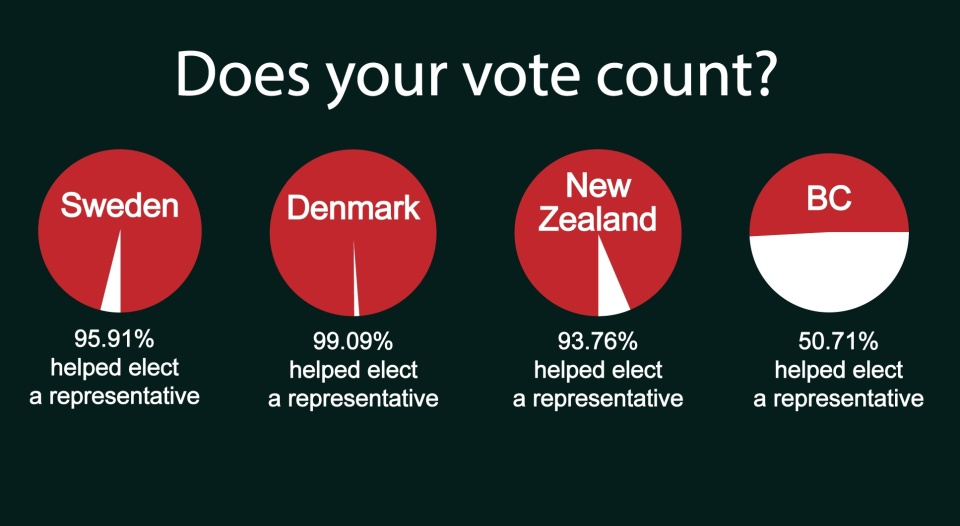
Why does this committee matter? It’s a genuine and very rare opportunity to fix the problems that plague our elections, and by extension, the way that we govern ourselves. Voters in BC, as elsewhere in Canada, continue to be frustrated by an archaic system that leaves most of us without effective representation (defined as having at least one elected representative who aligns with our values and priorities). Whereas most democracies upgraded to proportional representation about a century ago, we continue to muddle along using the antiquated first-past-the-post (FPTP) system.
FPTP distorts voter intent by enabling a party with only minority support to govern as though they had the support of a true majority of voters. Most of the ballots cast in each election don’t serve to elect anyone. Apathy, cynicism about politics, and low voter turnout are logical consequences.
To examine possible fixes, the Special Committee held hearings around the province this summer, and British Columbians came out in droves to share their thoughts.
Of the 161 presentations from individuals and groups that included an opinion on the voting system, a whopping 94% advocated for proportional representation. Proportional representation was supported by 29 of 31 organizations and 122 of 130 individuals who spoke to the committee.
The BC NDP can work with the Green Party and other independent-minded MLAs in the Legislature to implement reform—and we sincerely hope they don’t drop the ball. Upgrading our voting system would end the expensive policy lurch that cancels half-completed projects every time we change governments. It would encourage parties to work collaboratively and reduce the highly adversarial nature of our politics. Most importantly, it would ensure that the legislation that is passed reflects the priorities of a true majority of British Columbians.
An interesting idea floated recently by a member of the Special Committee, Kamloops-North Thompson MLA Ward Stamer, was to permit municipalities to use alternative voting systems. Specifically, Stamer suggested that voters might appreciate the opportunity to rank their preferred candidates 1, 2, 3 (as many as they like), rather than just mark their ballots with simple Xs. This simple, and hopefully uncontroversial, change could be the first step to improving political culture at the municipal level, particularly in places like Kamloops where there is so much acrimony among members of City Council.
Here’s what a new municipal ballot could look like after being filled out:
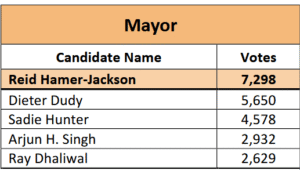
Reid Hamer-Jackson, a complete newcomer to politics, was elected to the Mayor’s chair thanks to the distortions of FPTP. Three experienced councillors split the vote, allowing Mr. Hamer-Jackson to come up the middle. Had voters been able to offer more nuanced choices via a ranked ballot, the result would quite likely have been different. Regardless of how you feel about Mr. Hamer-Jackson’s views, it is undeniable that a bit of familiarity with Council processes would have been helpful.
We say: Bring on electoral reform! Sure, give voters the ability to rank candidates on their municipal ballots, but don’t let potential reform at the municipal level become the shiny bauble that distracts our attention from what would be a truly transformative improvement: proportional representation at the provincial level.
We wish the Special Committee the political courage to do the right thing. Making evidence-based decisions and sticking to principles is a tough gig in politics, but making hard decisions in the best interests of the people of BC is what they were elected to do.
Transition Kamloops

Transition Kamloops is a volunteer-driven, registered not-for-profit society focused on increasing local resilience and self-sufficiency in food, water, energy, culture and wellness. We emphasize a local economy, healthy ecosystems, and grassroots community building, while reducing our dependence on fossil fuels. We believe in a better way: a community that sustains life in all its diversity, strives for equality and justice and invests in the future.
Transition Kamloops recognizes that we are living on Secwépemcul’ecw—land that was never ceded to settlers, and continues to be home to vibrant Indigenous cultures, languages, and traditions. We acknowledge the impact of colonization, forced displacement, and ongoing struggles faced by Indigenous peoples. We commit to listening, learning, and building positive relationships with Indigenous communities as we work towards reconciliation.
My Blog Posts