
Plastics treaty failure reveals a broken system
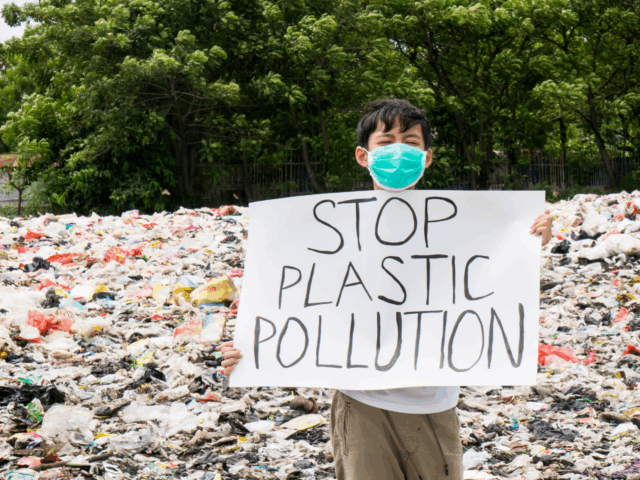
A young person standing amongst plastic waste in Indonesia. Plastic pollution is a major threat to human and planetary health.
After numerous attempts and delays, representatives from 184 countries failed to agree on a treaty to reduce and halt deadly plastic pollution. It’s another sign that we’ve fallen prey to a rapacious corporate consumer-capitalist system that concentrates extreme wealth and power in the hands of a few. Worse, those reaping the “benefits” don’t care that their actions are degrading and destroying planetary life-support systems.
Whether from malice, psychopathy, ignorance, greed or a combination, they see profit as the only guiding force. They’ve created a global system to facilitate this ever-increasing concentration of money and influence. While many are finding it increasingly difficult to afford necessities such as food and shelter, billionaire affluence is booming.
The lie is that these people deserve their riches, that their hard work and innovative ideas create jobs and maintain healthy economies for all.
According to a recent Oxfam study, billionaires’ wealth grew three times faster in 2024 than 2023, increasing by $2 trillion, and 204 more people became billionaires. The lie is that these people deserve their riches, that their hard work and innovative ideas create jobs and maintain healthy economies for all. But the Oxfam study found that 60 per cent of this obscene excess comes “from crony or corrupt sources, monopoly power, or is inherited” and that “Every billionaire under the age of 30 inherited their wealth.”
It’s telling that, while financial fortunes are increasingly concentrated and commanded by a few, most people are finding it harder than ever to keep up. Minimum wages (where they even exist) haven’t gone up in many places, a result of the increasing control the ultra monied and corporate entities have over governments and policy. Grocery and housing prices continue to rise.
The oil, gas, coal and related industries, including plastics and automobiles, exemplify and exacerbate this dire situation.
What caused the Geneva talks to fail after six rounds of negotiations? Efforts by petrochemical-producing countries including the United States, Russia and Saudi Arabia, and by the largest delegation attending, made up of 234 lobbyists from the fossil fuel and chemical industries, including ExxonMobil, Dow, the American Chemistry Council, Coca-Cola and others.
Plastic pollution is a major threat to human and planetary health.
Petrostates and corporations opposed measures to reduce accelerating growth in plastic production and legally binding controls on toxic chemicals used to make plastics.
Plastic pollution is a major threat to human and planetary health. According to the United Nations, “Every day, the equivalent of 2,000 garbage trucks full of plastic are dumped into the world’s oceans, rivers, and lakes.” Only nine per cent of plastics are recycled, with most of it burned, sent to landfills or released into the environment. It’s now everywhere on the planet, including in our bodies.
Plastic products have only been in widespread use since the 1950s. But they’re profitable. They’re also a byproduct of oil and gas. With the impacts of fossil-fuelled global heating increasing daily, the industry needs ways to continue reaping exorbitant profits — most of them returned to corporate executives and investors while fuelling inflation for everyone else. That means disingenuous moves like touting fossil gas as a climate solution and increasing plastic production, and pushing back against automobile fuel efficiency standards and electric vehicles.
The industry represents the pinnacle of a global capitalist system that continues to concentrate wealth at the top while forcing more and more people into poverty.
Fossil fuels and related industries are the most profitable in human history, and the most destructive, along with weapons, many of which help fuel petro-wealth. The industry represents the pinnacle of a global capitalist system that continues to concentrate wealth at the top while forcing more and more people into poverty. Multinational corporations strip minerals and oil from the Global South while moving profits through banking systems they created to facilitate this gross exploitation and inequality.
Plastic negotiations failed largely because curtailing this industry — protecting the global environment and the life that depends on it — threatens a system designed to give a small minority a disproportionately large share of money and influence.
One could argue the system is obsolete, but it was never that great to begin with. It’s just that the disastrous results of profit- and consumerist-driven avarice are now hitting home, with increasing pollution and climate disruption threatening our survival.
The failure of the plastics treaty is yet more evidence that the fossil fuel industry and its supporters in governments and media are just one powerful element in a system that isn’t designed with our interests in mind.
We need to wake up and take back the power.
David Suzuki

David Suzuki, Co-Founder of the David Suzuki Foundation, is an award-winning scientist, environmentalist and broadcaster. David is renowned for his radio and television programs that explain the complexities of the natural sciences in a compelling, easily understood way.
Education
As a geneticist. David graduated from Amherst College (Massachusetts) in 1958 with an Honours BA in Biology, followed by a Ph.D. in Zoology from the University of Chicago in 1961. He held a research associateship in the Biology Division of Tennessee’s Oak Ridge National Lab (1961 – 62), was an Assistant Professor in Genetics at the University of Alberta (1962 – 63), and since then has been a faculty member of the University of British Columbia. He is now Professor Emeritus at UBC.
Awards
In 1972, he was awarded the E.W.R. Steacie Memorial Fellowship for the outstanding research scientist in Canada under the age of 35 and held it for three years. He has won numerous academic awards and holds 25 honourary degrees in Canada, the U.S. and Australia. He was elected to the Royal Society of Canada and is a Companion of the Order of Canada. Dr. Suzuki has written 52 books, including 19 for children. His 1976 textbook An Introduction to Genetic Analysis(with A.J.F. Griffiths), remains the most widely used genetics text book in the U.S.and has been translated into Italian, Spanish, Greek, Indonesian, Arabic, French and German.
My Blog Posts