
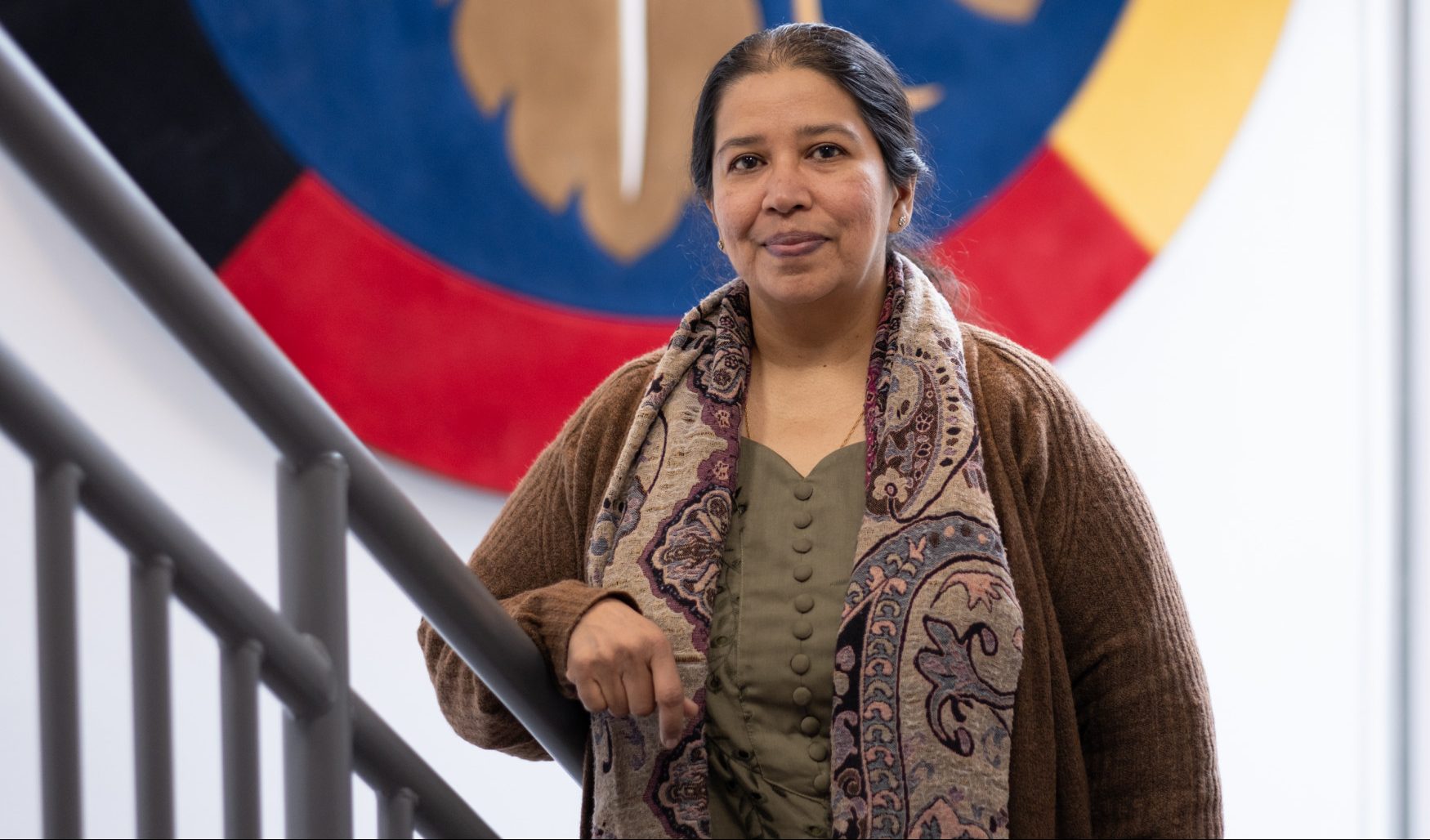
Visiting Sri Lankan scholar collaborates on disaster resiliency project
As the world faces increasingly devastating impacts of climate change like flooding, drought and wildfires, what can be learned about disaster resiliency from the practices of Indigenous people? And how can researchers work collaboratively with Indigenous people to document and share that knowledge?
Visiting scholar Dr. Fazeeha Azmi (University of Peradeniya, Sri Lanka) and TRU’s Dr. Bala Nikku from the Faculty of Education and Social Work are focusing on that as part of a SSHRC-funded research project. The project started in 2022 and examines how communities can better prepare and respond to natural hazards and disasters, and how community science can empower community members to build disaster resilient societies.
Throughout her academic career, Azmi has always been particularly interested in listening to and bringing forward marginalized voices
For this project, she is conducting community research into how the Veddhas, a Sri Lankan Indigenous group, are responding to climate change using traditional practices and building resilience in vulnerable situations. Due to development and expansion in Sri Lanka’s fishing industry, the Veddhas have historically been displaced and are now confined to certain areas. She feels an urgency to document how their traditional knowledge is being used because the group’s population is declining. They are losing members who would typically pass down the knowledge and practices to the next generation.
For instance, the group doesn’t fish year-round, they stop during certain periods to ensure fish breeding is taking place. They use a traditional method of salting fish to preserve their fish catch, and display a strong sense of community responsibility and communal bonds. Active members always share resources like fish or agricultural produce with members who cannot participate for physical or social taboo reasons (typically they are elderly, or divorced or single women). This strong system of social responsibility ensures everyone in the group is taken care of, despite how they are able to contribute.
According to Azmi, these traditional practices indirectly contribute to resource conservation and are examples of the Veddhas building resilience in the face of climate change.
An intensive two weeks
Azmi just completed a two-week visiting scholarship (November 15 – 30) hosted by TRU’s School of Social Work and Human Service, and in addition to the duo’s work on the research project, they had a full agenda. Azmi and Nikku:
- Co-wrote an article: Small Scale Fishers in South Asia and Resilient Futures: Case Studies from Sri Lanka and India.
- Organized and hosted a colloquium presentation at TRU: Resilience Reimagined: Building a Resilient Sri Lanka.
- Co-delivered a presentation at the University of Manitoba, Natural Resources Institute: Caught in the Current: Vulnerability and Resilience among small scale fishers in Eastern Sri Lanka.
Azmi’s time here was crucial to the current research project and exploring new grant funding, according to Nikku.
“Hosting visiting scholars like Dr. Azmi from the global south is critical to the co-production of resilient knowledge that the research project aims to address. This is one way of decolonizing research knowledge production, and is something very vital to my own research practice,” he says.
“Her visit has been essential in contextualizing the research, which focuses on knowledge co-production with communities in BC, Nepal, India and Sri Lanka — the case study countries included in this (New Frontiers in Research Fund) NFRF-funded project.”
This project ends in February, but Nikku and Azmi plan to apply for grant funding to continue the work. The next step in the project would be applying the co-produced knowledge and documenting how Indigenous communities build disaster resilience. Azmi explained they are considering different methods of knowledge sharing using technology, only if the communities are interested.
“It’s very important to have good discussions with people in the community about whether they need the technology at all. While we talk about protection of the environment and sustainability, protection of culture is very important. When we look at a change, it must be a change that they like,” she says.