
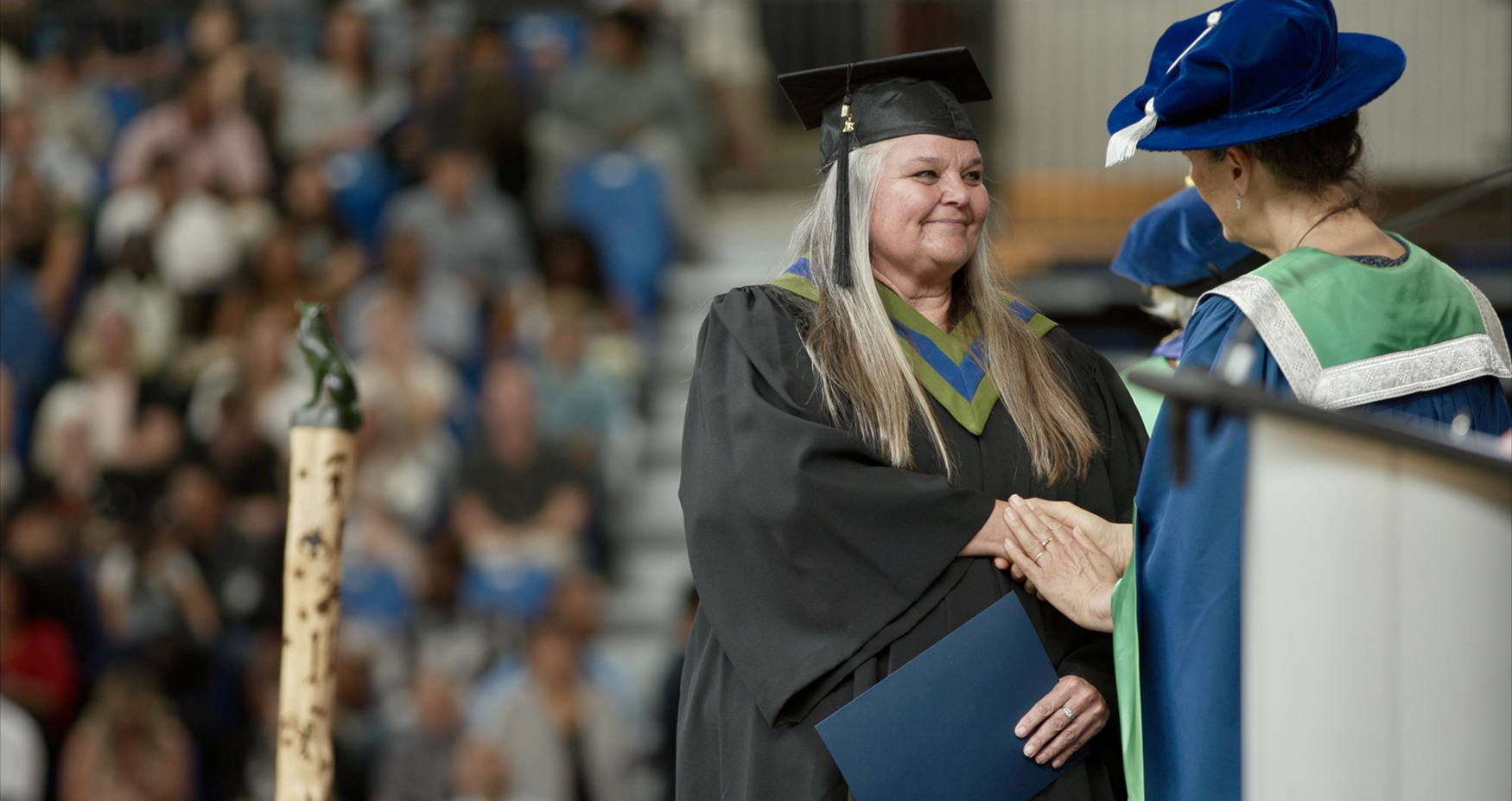
Graduates and guests celebrate Spring Convocation 2026
Nearly 2,000 students crossed the stage during Thompson Rivers University’s Spring Convocation ceremonies last week, cheered on by family members, friends, classmates, instructors, mentors and supporters who helped them reach the milestone. As graduates celebrated years of learning, growth and perseverance, a common message emerged throughout the ceremonies: no one reaches convocation alone.
The importance of community and connection was reflected throughout convocation week and captured in a message from TRU Chancellor DeDe DeRose.
“The words and songs shared today by the Secwépemc drummers, singers and Elder remind us of the depth of our connection — to one another, to community, to the land and to those yet to come,” said DeRose.
“Education does not occur in isolation; learning is relational. Your success is inseparable from the people and communities who have supported you and your future contributions will, in turn, strengthen the lives of others.”
For many graduates, those relationships will be among the most enduring parts of their university experience.
The people who made it possible
“I came here knowing nobody and I’ve met so many amazing people who will be with me for the rest of my life,” said Madi Martens, a Bachelor of Arts graduate majoring in English. “It’s been a time of growth for me.”
Economics major Sochy Ajoku said the friendships and opportunities he found at TRU transformed his experience.
“When I came to TRU, I was quite introverted. I wasn’t outgoing,” he said. “Because of the people I was surrounded with and the friends I made, it brought out the social person in me.”
Eunice Loshima, a sociology major, reflected on the personal growth she experienced during her studies.
“It’s been an adventure,” she said. “I’ve been involved in a lot at TRU. Having to close this part of my life will be the hardest thing I’ve done so far. It’s been beautiful. I’ve grown and built charisma.”
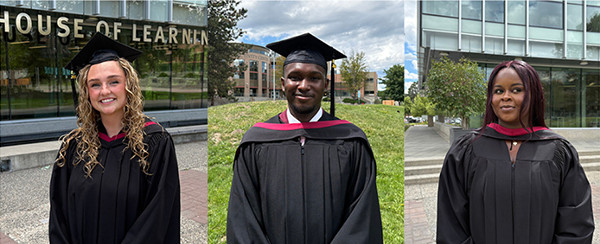
Bachelor of Arts students Madi Martens, Sochy Ajoku and Eunice Loshima highlight the people they’ve met along the way as a transformative part of their TRU experience.
No one succeeds alone
Master of Education graduate John Paul Vallente, co-valedictorian for the Faculty of Education and Social Work, reflected on the Filipino concept of bayanihan, a spirit of communal unity and collective effort he described as “collective lifting.”
“Perhaps it is fitting that there are two of us because in every field that’s represented in this room today, no one has ever truly done the work alone,” said Vallente.
Recalling a story from his grandfather about neighbours coming together to move a family’s home to safer ground, Vallente encouraged graduates to carry that same spirit into their communities.
“And yet we showed up and we lifted each other because TRU has been educating us not only to know more, but to care more, and to hold steadier when the storms come,” he said. “Let’s go and carry that same spirit of collective lifting into our communities and into our world. And let us move together.”
Honorary degree recipient Ann McCarthy, Doctor of Letters, shared a similar message while reflecting on her experiences as a cancer survivor, researcher and community advocate.
“It wasn’t science, trades, or technology alone that allowed me to survive,” she said. “It was the belief in what’s possible when those things collaborate.”
McCarthy spoke about the power of partnerships, lifelong learning and community support, reminding graduates that some of life’s greatest achievements are built through the combined efforts of many people working together.
Carrying the TRU spirit forward
Before each ceremony, President and Vice-Chancellor Airini greeted guests as they filled the stands at Tournament Capital Centre, and in her opening remarks she recognized a few of the family members, supporters, travellers from afar and distinguished community leaders who had gathered to celebrate graduates.
“Thank you to families and supporters,” said Airini. “As has been said, your encouragement, your sacrifices, your unwavering belief in our graduates today have made this possible. You are vital to this success.”
Addressing the Class of 2026, Airini praised graduates for their resilience and encouraged them to carry the spirit of TRU into the future.
“We see, and we salute your resilience, your creativity, your courage,” she said. “You have faced challenges, you’ve adapted to change, and you’ve grown into leaders. The future looks bright.”
In a week of memorable moments, not just for graduates but the entire TRU community standing behind them, a highlight was the conferral of five honorary degrees, including a Doctor of Letters, honoris causa, upon Secwépemc Elder Mike Arnouse. A central figure in Indigenous education at TRU, “Uncle Mike” was the first Elder-in-residence to support students on campus. As President Airini presented Dr. Arnouse with the TRU sash, graduates responded with a standing ovation, and members of his family sang and drummed an Honour Song.
Read more: Extraordinary leaders celebrated with honorary degrees
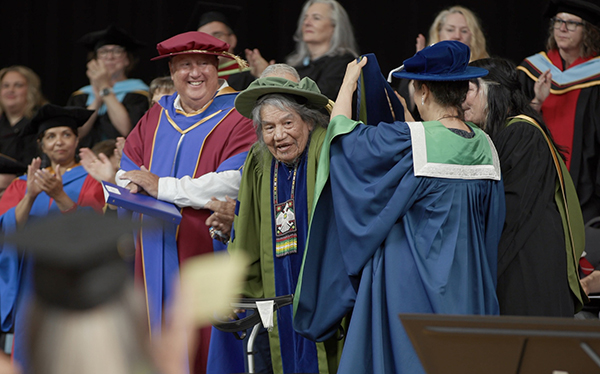
Secwépemc Knowledge Keeper and Elder Dr. Mike Arnouse receives a standing ovation on the conferral of his Doctor of Letters, honoris causa from TRU.
As the Class of 2026 prepares for what comes next, DeRose encouraged graduates to embrace new opportunities and connections.
“As you leave this place and begin the next chapter of your journey, remember always to believe that something wonderful is about to happen.”
Convocation by the numbers
- 2,989 credentials awarded across the Williams Lake and Regional campuses (89), Kamloops campus (2,380) and Open Learning (520)
- 2,611 undergraduate and preparatory credentials awarded
- 378 graduate credentials awarded
- 260 credentials awarded to students who self-declared Indigenous ancestry
- 73 countries represented
- 120 programs
- 41 medals awarded to 40 students
- 10 valedictorians
- Five honorary doctorate recipients
- Four emeriti recipients
- 90 staff and faculty assisting behind the scenes
- Three new credentials celebrated their first graduating class: the Wildfire Science Certificate, Wildfire Communications and Media Certificate, and Sociocultural Dynamics of Wildfire Certificate