
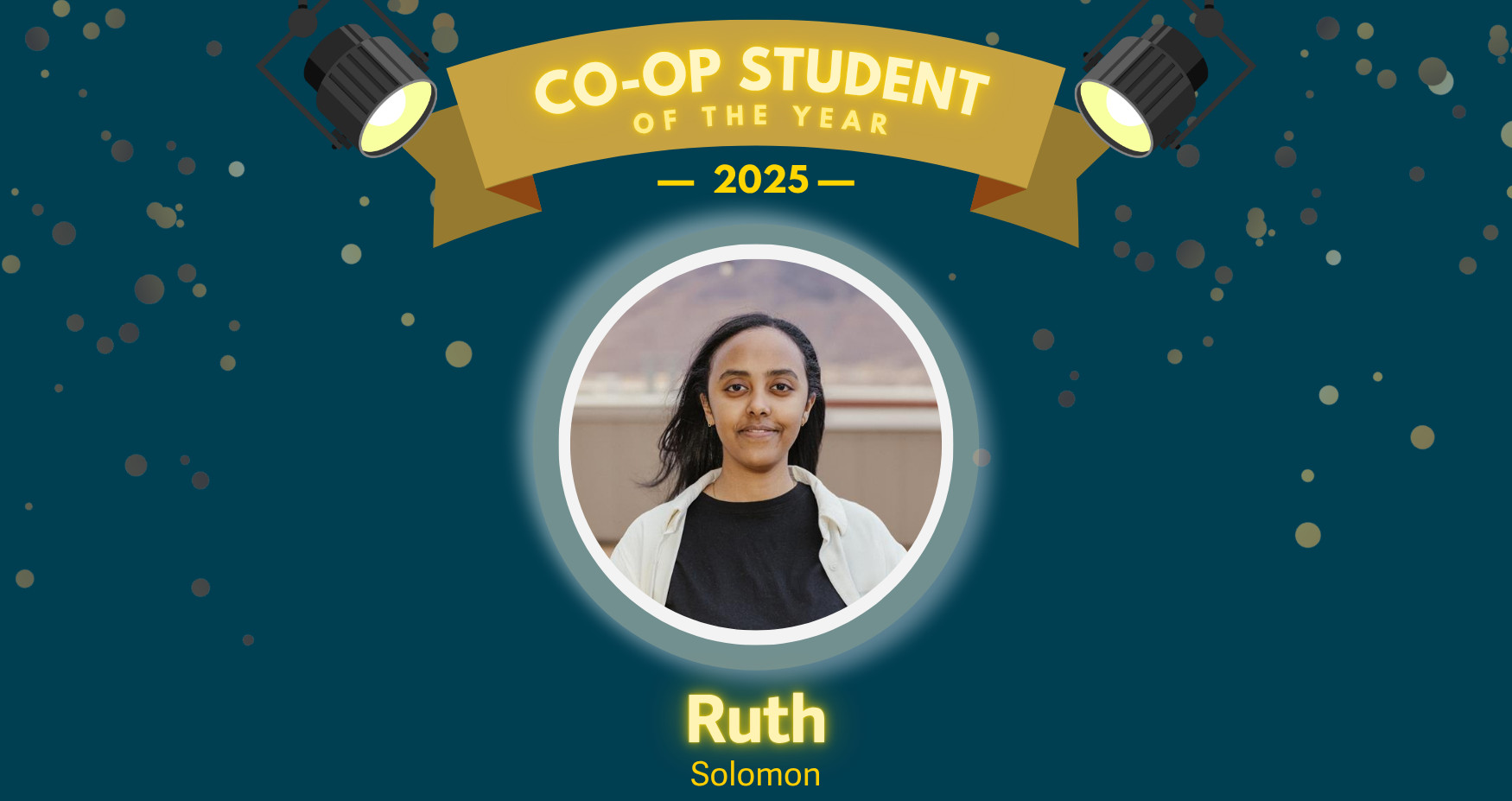
Co-op award winner learns how to thrive
Ruth Solomon Befikadu had a fairly clear picture of what co-op would look like before she started. A self-described reserved person, the fifth-year Bachelor of Software Engineering student expected a quiet desk, a screen, and room to work on her own. What she got instead were three placements that pushed her into a new way of learning, communicating, and showing up for herself and the teams around her.
Across two roles at the BC Lottery Corporation (BCLC) and her most recent position as a software engineer intern at Trimble, Solomon Befikadu built a working philosophy grounded in curiosity, initiative, and one lesson she says she carries into every new environment: knowing when to stop working alone and ask for help.
Putting yourself out there
Her first co-op at BCLC landed her on a small, busy data analytics team that, by her own description, was far more communicative than she expected. The adjustment was real.
“BCLC was a more community-oriented company, and my team were fairly communicative, so that was uncomfortable at the beginning,” she said. “But you end up learning from people, learning how to communicate in a corporate setting, not only how you communicate with your friends.”
Her mentor became an anchor in that adjustment. A daily check-in gave Solomon Befikadu a consistent space to practice talking through her work, and that structure paid off when her mentor asked her to present her first-ever project to the full data analytics team.
“Putting yourself in an uncomfortable situation helps you get used to it and face the fear that you have. I think putting myself out there helped me overcome that one.”
Impact you can measure
From early in that first term, Solomon Befikadu was handed real work with real stakes. Her first major project came during a system transition: the team needed a dashboard to help organize data and flag issues as they surfaced. Knowing it would be the first thing her team opened every morning, she treated the quality of that work as non-negotiable.
“I knew my team was going to use that dashboard every day, so I put in a lot of work to make it look nice and, most of all, be very accurate. That definitely saved the team a lot of time because they’re really busy and small in number.”
She also identified a manual process that required one specific person to be physically present on one specific day each month, with no backup if that person wasn’t available. She didn’t wait to be assigned the problem.
“I saw that this process was done manually, and I knew I had experience with automating things. So, I asked my mentor: if I were to automate it, would it be of use?”
The answer was yes. Together, they defined the requirements, and the result was a fully automated process that no longer depended on any single person’s presence. That kind of initiative, spotting a problem outside her own scope and bringing a proposal to the table, is the kind of contribution that tends to stay with a team long after a co-op term ends.
Two weeks, a new framework, and no time to hesitate
Trimble was a different kind of test. The team was small, the pace was fast, and the product was new to the organization. Solomon Befikadu had roughly two weeks to get up to speed on a framework she had never worked with before, using a programming language she had never touched, before getting straight into the work.
“Starting off, you definitely feel a little scared and out of place. But I asked immediately for a job to do, because I learn better when I do instead of just sitting down and reading.”
Getting into the work quickly is what made the learning stick, she says. And seeing her code go live and reach real customers, on a product just getting started, gave the work a weight that mattered.
“As a student, seeing the things I worked on, the code I worked on, getting pushed and being used by customers, I thought was pretty cool.”
Knowing when to stop and ask
Across all three terms, the question Solomon Befikadu kept returning to was the one every co-op student eventually faces: when do you keep pushing on your own, and when do you reach for help?
Her method was deliberate. Try. Try again. Document every attempt, what she did, why it didn’t work, and what she tried differently. Then, after a point where she was no longer making progress, ask.
“I tend to write down what I did if I tried to solve a problem eight times. After a certain point, it doesn’t make sense to stay there. Knowing that limit, knowing when you’ve plateaued, that’s when you need to ask for help from your mentor.”
Her mentors noticed. Feedback she actively sought out across her terms reflected this pattern back to her as a genuine strength, one that took self-awareness to build and consistency to maintain.
Showing up as a problem solver
For co-op students asking what it actually looks like to go above and beyond, Solomon Befikadu offers a grounded answer. It starts with paying attention to the people around you.
“You have to familiarize yourself with the team, be in communication with the core team members, especially those who have a lot of work, because where there is a lot of work, there’s probably a way to make it easier.”
The work itself is only part of the picture. A solution that solves the problem for you might not solve it for the person who actually has to use what you built. She puts herself in that person’s position before she calls something done.
“The way you look at issues needs to be from another person’s perspective. What does their day look like? What do they do first, and what comes next? How do we solve this in a way that actually makes it easier for them?”
What comes next
As graduation approaches, Solomon Befikadu has a clear direction. She plans to pursue her professional engineering accreditation and is drawn to roles in robotics, medical engineering, or firmware and hardware development. Three terms across three different environments have only sharpened that focus.
She credits the CEL team for their role throughout the process, from resume support during her initial application to the mid-co-op evaluations that gave her employers a structured way to observe her work.
“Those questionnaires helped my employers look at me closely and identify some of my flaws, which they were really straight with, and also the strengths that I needed to reinforce more.”
Her advice for students just getting started is practical: show up ready to learn, keep your eyes open for problems, and build the courage to ask for help when you need it. The problems will be there. So will the people willing to help you through them.
Co-op Student of the Year is an annual award that recognizes outstanding achievement in all aspects of a co-op student’s performance, including academic achievement, work-term learning, job achievement and employer evaluation, personal statement, co-operative education, and contribution to extra-curricular activities and the community.
Learn more about Career and Experiential Learning at tru.ca/cel.