
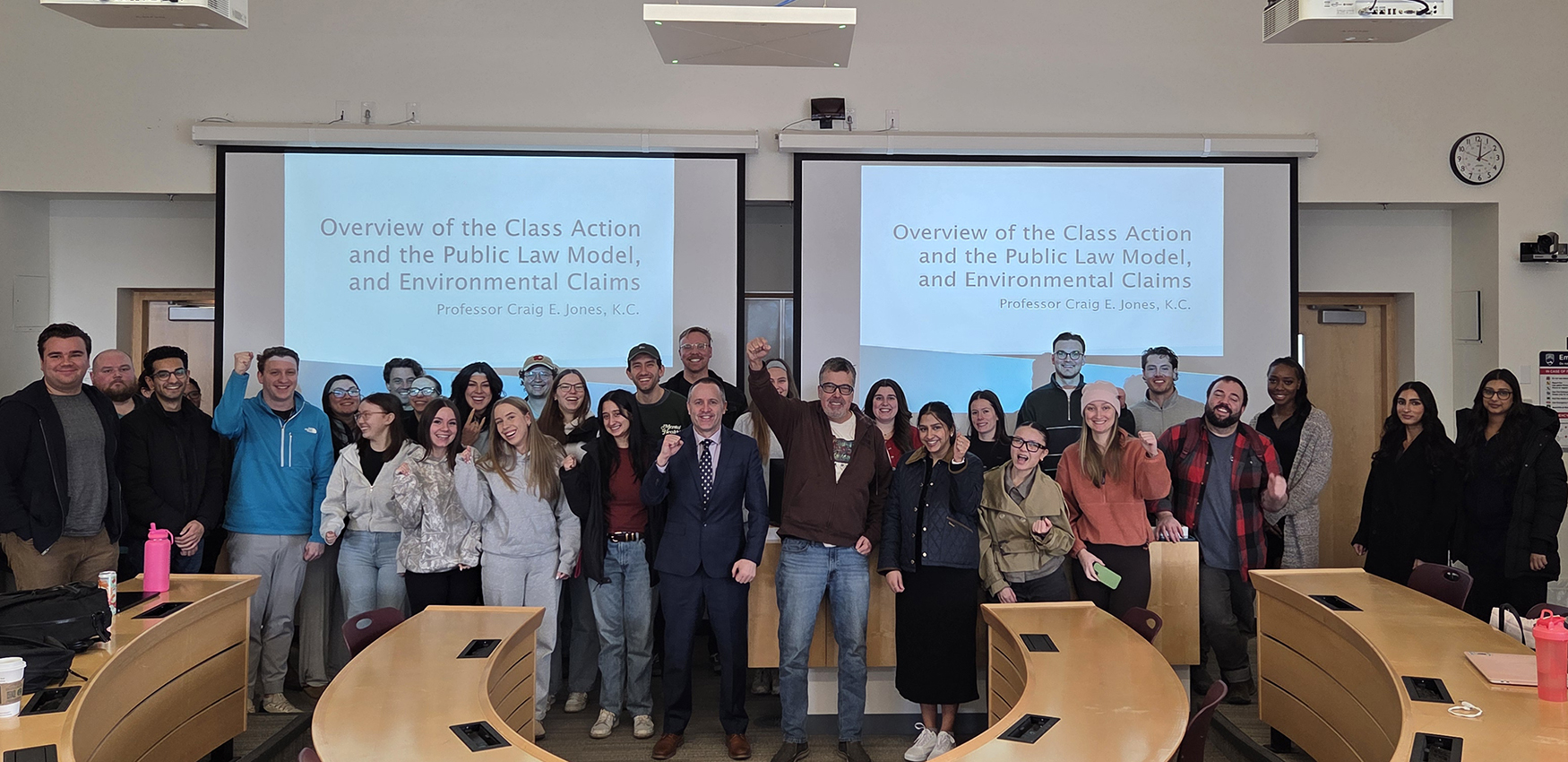
Exploring the role of class actions in environmental litigation
Students in the Environmental Law class at TRU’s Faculty of Law were treated to a thought-provoking lecture on Wednesday, Feb. 11, from Craig E. Jones, KC on the role of class actions in environmental litigation. Professor Jones is the Editor-in-Chief of the Canadian Class Actions Review and author of seminal works like Theory of Class Actions and The Law of Large-Scale Claims.
Jones focused his presentation on the theory and function of class actions, particularly in the context of environmental harms and toxic torts. While class proceedings are often understood primarily as procedural tools for managing large, complex disputes, Jones urged students to look deeper, at the philosophical underpinnings of tort law itself.
At the heart of his thesis is the idea that the purpose of tort law, writ large, is behaviour modification.
“Professor Jones is an extraordinary educator,” said Professor Murray Sholty. “He possesses a rare gift and ability to lead the students through a rigorous exploration of the Public Law Model, masterfully balancing the complexities of ‘probabilistic causation’ with the practical imperative of ‘behaviour modification.’”
“Whether he was deconstructing the ‘economies of scale’ inherent in aggregate litigation or drawing on his experience arguing landmark cases like Douez v Facebook, he provided an invaluable presence that profoundly enriched our classroom experience.”
“Compensation matters,” Jones acknowledged, “but the point of tort law is not just to compensate victims.”
If simple compensation were the sole objective, he explained, society could rely on no-fault insurance regimes, which are far cheaper and more efficient than tort litigation. Instead, tort law serves broader goals: compensation, yes, but also deterrence.
Jones distinguished between specific deterrence, aimed at preventing a particular wrongdoer from reoffending, and general deterrence, which signals to the broader community the standard of acceptable conduct. Together, these mechanisms operate to shape behaviour. In that sense, tort law functions as a regulatory force. This is particularly significant in environmental contexts where corporate or governmental actors make decisions with far-reaching public consequences.
He also pointed to the restorative principle of restitutio ad integrum — the idea that a plaintiff should be restored, as nearly as possible, to the position they would have occupied had the wrong not occurred. Yet Jones challenged students to confront a hard truth: the only way to truly make someone whole is to prevent the injury before it happens. From that perspective, prevention, achieved through behaviour modification, becomes tort law’s most meaningful ambition.
Class actions, Jones argued, are a critical vehicle for achieving these goals. They provide plaintiffs with the same economies of scale that defendants (particularly large corporations or public bodies) enjoy as a matter of course. By aggregating claims, class proceedings level the procedural playing field, offering equal efficiency to both sides. Without aggregation, many environmental harms would go unaddressed, as individual claims would be too costly to pursue.
At the same time, Jones was candid about the limitations and disadvantages of class actions. Certification hurdles, complex evidentiary burdens, and lengthy timelines can complicate proceedings. Nowhere are these challenges more pronounced than in toxic tort litigation.
Toxic torts, he explained, present “huge problems” in causation. How, for example, does a plaintiff prove harm from exposure to pollutants emitted near a beehive burner or similar industrial source? When a community living near a contaminant source experiences increased illness, isolating causation for each individual, and linking it to a particular defendant, can be extraordinarily difficult.
Jones suggested that the principle of general causation might be the key to solving this decades-old causation problem. General causation refers to the scientific, evidentiary requirement that a specific substance or chemical can cause the alleged disease, illness, or injury in the general population. It establishes a general link between exposure and harm, distinct from “specific causation” (which ties that harm to a particular individual’s exposure).
This has huge implications in the toxic tort context, Jones explained. Where a class can demonstrate, for example, that the pollutants emitted by the beehive burner have the potential to cause higher rates of birth defects among residents living within X number of kilometres of the burner, and that those members living within X number of kilometres of the burner did, in fact, experience those higher rates of birth defects, they should be successful in having their claim certified as a class proceeding.
“Professor Jones’ lecture was so compelling because of his ability to convey not only the theoretical foundations of mass tort law in Canada, but also to situate class actions within a broader policy framework,” said 3L student Brendan Semchuk.
“He reminded us that litigation is not merely about resolving disputes through compensation, but about shaping legal standards and fostering meaningful accountability.”
The visit offered Environmental Law students a rigorous exploration of how class proceedings operate not only as litigation tools, but as instruments of deterrence, accountability, and social regulation, especially in the high-stakes arena of environmental harm.